Monthly Archives: March 2014

Back in Adelaide

We have been tucked up in Adelaide since Saturday afternoon and plan to be here until about 3 April.  This is one of our few excursions into a Big 4 Holiday Park but unfortunately we did not have any other options – there are no low cost or free camping opportunities close to the big cities. On the up side, we are close enough to walk most places we need to go and are near the tram route into central Adelaide for our city tasks.

We have quite a list of things we need to achieve before we depart here on 3 April so we will be busy most days. As per our ‘new life’, we have put plenty of time aside for the social calendar.

Will keep you updated.

Categories: Uncategorized | Leave a comment

In the Barossa

When we departed Kapunda on Sunday and drove into the Barossa and to one of Dearne’s ‘must visits’ – Maggie Beers Farm Shop at Nuriootpa.  Dearne became a fan of Maggie through Masterchef Australia and watching her cook on “The Cook and the Chef”. When Maggie first arrived in the Barossa three decades ago, there was little awareness of the importance of the region’s traditional food culture however she soon became a champion of Barossa food.

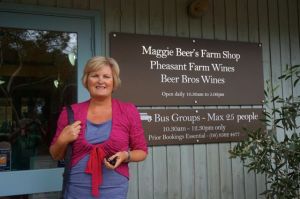
Dearne at Maggie Beer's

Dearne in her element at Maggie Beer’s farm shop and restaurant

Maggie Beer’s Farm Shop and Restaurant is located at the original Pheasant Farm Restaurant site in the Barossa. Her full product range of locally sourced gourmet foods, including Pheasant Farm Pate, quince paste, verjuice and ice creams are available along with a full café facility (including their Pheasant Farm Wines). We spent a great hour or so looking around the Farm Shop and the attached farm from where the shop sources much of its raw products.

After leaving Maggie Beers we continued our Borossa travels and at the same time, searching for somewhere to stop overnight.  As we passed through the little village of Eden Valley, we noticed a few caravans at the local sports ground so we drove on in and discovered for the princely sum of $12 per night we could have a parking spot, hot showers, power and toilets.  The closer you get to the main centres in Australia, there are very few free or low cost parkup opportunities. We were happy with the $12 so that was us for the night.

Vineyards in The Barossa

A little slice of the Barossa heaven. After a while all the tastings blend into one.

Monday morning we left Eden Valley and visited the villages of Springton, Mt. Pleasant, Mt Torrins and Birdwood ending up in the township of Mt Barker. We made Mt Barker our base for three days, unhitched the jeep and toured as much of the Barossa as we were able. At least driving the jeep we could participate in a couple of wine tastings whereas in the motorhome it is ‘zero tolerance’. We now have enough of the local product to last us for a couple of months.

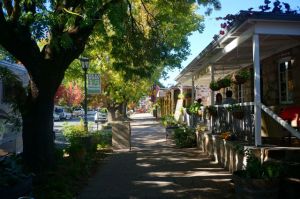
On Thursday we made our way to Hahndorf, a small village classified as Australia’s oldest surviving German township and settled in 1838. The most striking feature that greets you as drive into the village are the 100-year-old elm and plane trees that line the main street.  The original fachwerk (half timbered) buildings, many restored to their original condition, reminded us of the village buildings we came across while on our visit to Germany a couple of years ago.

Main Street in Hahndorf

Main street Hahndorf – a stunning little village

While the town has retained its strong German heritage, there was plenty to take in and enjoy. Hahndorf has a unique village feel about it and with the two hotels offered authentic German fare and the numerous cafes, restaurants and wineries enticing us to enter, Hahndorf has been easy place to stay for a couple of days.

We leave here tomorrow morning (Saturday) and make our way into Adelaide for our 10-day ‘layover’ to prepare for our journey up the middle.  The freezer is empty, we need to get our Carnet documentation resigned to reflect the extension, the duvets need dry cleaning (being constantly on the road plays havoc with clothes and bedding you cannot normally wash in a washing machine) and there is a little bit of maintenance to do on the motorhome. ‘Getting it right first time’ is going to be the key to enjoying the next part of our journey.

We occasionally get emails from blog readers saying we never mention the ‘not so good’ things that happen to us on our journey. To tell the truth, we have either been very lucky or very cautious as we have yet to experience any really bad situations. The people we meet are generally very hospitable, friendly and helpful. We have come across most type of wild animal/reptile/insect on our many walks (with the exception of crocs and alligators) and Dearne’s bush tic encounter in the Bunya Mountains has been our only health scare. We both know we would lose any clash we had with a snake, alligator, crocodile, certain spiders, emu or kangaroo so we are very careful how we interact with the animals, we never park up alone (unless its in a public place), we are careful on the type of roads we drive the motorhome (except the once) and we always lock things away at night or when we are not around. We have been advised to be extra vigilant on our journey up the middle next month and during our time in the Northern Territory. There are apparently some devious and opportunist characters up that way so we intend to heed the advice.

It will be all part of the adventure.

Categories: Uncategorized | Leave a comment

Departed the Yorke Peninsula

Dearne at Tiddy Widdy Beach

At the popular Tiddy Widdy Beach just north of Androssan on the York Peninsula

Wednesday morning we departed Edithburgh and did a slow crawl up the eastern coast of York Peninsula calling into Coobowie, Stansbury, Port Vincent, Port Julia, Black Point and Ardrossan. They are all very small coastal communities but unique in their own way. Many are the home to huge grain silo facilities with long feeders extending out into the Gulf St Vincent for the loading of ships and barges.

Towards the end of Wednesday we drove inland to our overnight stop at Arthurton where the local Catholic Church extends an invitation to travellers to ‘rest’ behind the church. There were three other vans there overnight so it was quite a pleasant 5 o’clockers.

On Thursday morning, and with some reluctance, we continued north and out of the Yorke Peninsula. We topped up with fuel at Port Wakefield then continued further north to Snowtown, the South Australia settlement known for the ‘Snowtown murders’.

Snowtown Murders Bank

The ideserted bank at Snowtown where the eight bodies were found in 1999. Interestingly, the shops either side of the bank are also still deserted

Between 1992 and 1999 a small gang from Adelaide murdered 11 people from the South Australia area. In May 1999, the remains of eight victims were found by the South Australia Police in six plastic barrels in an unused bank vault in the main street of Snowtown.

Though motivation for the murders is unclear, the killers believed that the victims were deviants or “weak”. In at least some instances, the murders were preceded by torture.  Interestingly, none of the perpetrators or the victims were from Snowtown itself. The notoriety of the murders led to a short-term economic boost from tourism but created a lasting stigma. There are very few in the town who wished to discuss that part of their history.

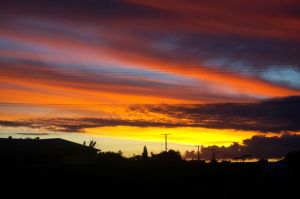
Sunset at Snowtown

Sunset at Snowtown before the storm

We departed Snowtown yesterday morning and are making our way slowly back to Adelaide (arriving Saturday 22 March) where will spend a week or so preparing the motorhome (and ourselves) for our journey up through the middle in mid April.

Our intention is to spend the next seven days the Barossa area experiencing the pleasures of South Australia’s ‘Garden of Eden’. We have both been here before but it was some years ago so we are looking forward to the next week. We are currently in the township of Kapunda, just north of the Barossa, and will probably stay here until Monday when we will drive into the Barossa itself.

Categories: Uncategorized | 2 Comments

From Innes National Park to Edithburgh

Our parkup at Pondalowie Bay, Innes National Park

Our parkup at Pondalowie Bay in the Innes National Park

The Innes National Park was the perfect place to spend the long weekend relaxing and not having to travel. While we don’t mind the ‘roady’ journey, it is good just once in a while to stay put for a few days. Interesting though, by Monday morning we both had itchy feet and were very happy to be on the road again.

We undertook some stunning walks while at ‘the Innes’.
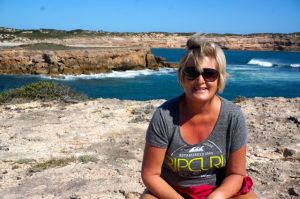
Dearne on Cape Spencer, Innes National Park

Dearne on our Cape Spencer walk in the Innes National Park

We visited Inneston which, in the early 1900’s, was home to some 200 gypsum miners. Rock gypsum, the type found here, is a soft white mineral and when crushed, refined and dried, sets into hard permanent cement or plaster – an innovative building product of that day. Although the site has been abandoned for decades, considerable effort has been made to provide an attraction where visitors can learn about this special part of South Australia’s history.

Around the perimeter of the Park a walking track highlights the tragic marine history of this dangerous coastline. No less than 40 shipwrecks are found on the coast – some of these quite visible from the tracks. We climbed down the cliff at Ethel Beach where the barque ‘Ethel’ came to rest. On 2 January 1904 she was blown off course and struck a reef off Cape Spencer. With a damaged rudder and battling strong winds, she was blown ashore. The wreck is still very visible in the sand.
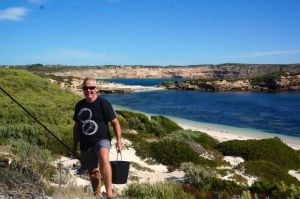
Rod returning from fishing

Rod still cannot resist throwing a line in the water when we are anywhere around the coast

While the coastline itself is mostly bare rock, the hills away from the coast are covered with low scrub – very similar to our tea-tree. As we discovered, it is the perfect habitat for possums, the grey kangaroo, emu and a huge variety of other birds. The Park’s reptiles love sunning themselves on the roadsides so one had to be ‘animal’ aware when driving. There is a 40km speed limit throughout the park.

On Monday morning it was back on the road and on to Yorketown. Yorketown is a 100km drive from the National Park and is surrounded by some 200 salt lakes. The town originally had a history of harvesting the lakes but nowadays the salt formations are a boon for photography tourism.

A Yorketown Salt Lake

A typical Yorketown salt lake – the pink is real and looks stunning

We were hoping to stock up on a few essential items at Yorketown however we came unstuck as Monday was the public holiday and in Australia a ‘public holiday’ means a ‘public holiday’. Nobody works and Yorketown was shut down. We were down to our last 25 percent of fresh water, we needed an LPG top up, the captain had run out of Coruba (the wine cellar was still looked good) and the fridge/freezer was rather bare.

We decided to carry on to Edithburgh hoping that something would be open however we found the same situation. Our only success, to the captain’s delight, was the local hotel was open and they stocked Coruba.  Luckily we had enough food onboard to get us through another night. We made Edithburgh our overnight stop on Monday.

We made the decision to stay at Edithburgh until Wednesday and this morning (Tuesday) drove the jeep back to Yorketown to stock up on our supplies. We spent a pleasant day looking around the area and we are now back at the motorhome just in time for ‘happy hour’. We managed to achieve everything we set out to do today.

We have just received a weather bomb warning for this part of the Yorke Peninsuala. We were advised to expect 80kt winds, heavy rains and thunderstorms in the next few hours. We are battened down and have moved well away from any trees.

Tomorrow morning we will continue up the east coast of the Yorke Peninsula and back into the Gulf St Vincent. We have been reliably informed that there are a number of crabbing opportunities along the coast so it was a brilliant decision to keep the crab rake from our last adventure.

Categories: Uncategorized | Leave a comment

The bottom end of Yorke Peninsula

Dearne at Port Hughes

Totally relaxed at Port Hughes

Our Monday overnight at Port Hughes, just out of Moonta, was very pleasant. We were parked up at the local beach car park, beside the beach and only a two-minute walk to the Port Hughes Seaside Bar.  This was fortuitous as we had some great news on Monday afternoon. We received an email to let us know that Australia Customs had approved the extension of our Carnet document to give us our second year of travel in Australia.  We decided to adjourn to the Seaside Bar to celebrate our victory.

Tuesday morning we drove out of Port Hughes not really knowing where we were heading. We had decided not to visit the little fishing hamlets between Moonta and Hardwicke Bay on the Peninsulas’ west coast as the access roads to the hamlets are unsealed i.e. dirt, dust and corrugated. Instead, we drove to the centre of the Peninsula and spent Tuesday night in the township of Maitland and Wednesday night further south at Minlaton. Our Minlaton visit was most productive, as we had been experiencing a couple of onboard ‘IT’ problems that have now been resolved by an IT expert in the town.

Thursday morning we learned that it is a long weekend in South Australia this weekend so we decided we would stop for a few days and keep out of the traffic. We made the Innes National Park our destination.

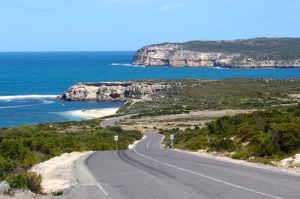
Driving into the Innes National Park

Driving into the Innes National Park at the bottom of Yorke Peninsula

The Innes National Park is on the southern tip of the Yorke Peninsula and comprises some 9415 hectares of spectacular coastal landscapes, natural coastal vegetation and a diverse range of wildlife. The Park takes it name from William Innes who discovered commercial quantities of gypsum in the area in the early 1900’s. The area was originally colonized in 1847 with land occupied for sheep grazing and cropping.

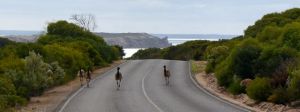
Emus in Innes National Park

Our emu encounter on the way to our parkup in the Innes National Park

The Australia National Park code is very similar to our National Parks in New Zealand i.e. no pets, take out your own rubbish, do not feed wildlife and so on.  We find it very difficult sometimes to obey all the rules, – especially the ‘don’t feed the animals’ bit as they come right up to the van looking for a bit of attention. The magpies and parrots sit at your feet waiting for the crumbs to drop and the ‘roos and emus’ are just plain nosy.The wildlife over here still amazes us.

Cellphone coverage in the Park is very poor so if anyone needs to get hold of us, please try texting first and if it is urgent, we will then drive out of the Park.

A pristine place to stay – we have decided to stay here until Monday.

Categories: Uncategorized | 3 Comments

On the Yorke Peninsula

When we told fellow travellers we were going to spend 10 days or so on the Yorke Peninsula we were told ‘not to bother as there was nothing there’.  We are loving being here. The scenery is brilliant, there is plenty to see and the locals encourage your visit by providing the option of free camping areas. We have been on here three days now and are only one third of the way down the west coast.

We stayed Friday night in Port Pirie and spent Saturday stocking up at ‘Woolies’ and having a good look around the city. The standout feature in Port Pirie for us was the worlds largest lead smelter plant operated by Nyrstar on the outskirts of the city. – the site was huge. The smelter has been in production since 1889 and in addition to its lead production, it also produces refined silver, zinc, copper and gold.

Late Saturday afternoon we drove further south into the Yorke Peninsula to the township of Port Broughton. The place was very picturesque and I think we would have stayed there the night but there was no free camping allowed and the camp ground was asking A$32 a night for a bit of grass to stop on.  You know our feelings on that so we carried on to the hamlet of Alford.

Alford consists of one hotel, a half a dozen homes (occupied) and three shops (unoccupied). Its primary attraction for us was their complimentary overnight parking at the local sports ground for self-contained motorhomes and caravans. We were joined later in the evening by two German girls touring Australia in their car. A lovely quiet spot, a great evening and highly recommended if you are on the Peninsula.

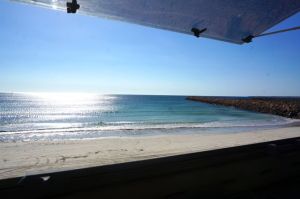
Our parkup at Wallaroo

The view from the motorhome window at our Wallaroo parkup

On Sunday morning we made our way 27 kilometres to the west coast of the Yorke Peninsula and into the township of Wallaroo. Wallaroo settlement was established on Wallaroo Bay in 1861 and was proclaimed as a town in 1862.  Wallaroo today is a deep-sea port and is home to the Spencer Gulf prawn fleet. The Wallaroo jetty is one of the most popular in the state for fishers whilst under the jetty divers have access to a variety of sea life.

We stayed on the Wallaroo waterfront at the Wallaroo boat ramp  – an area of about 2 hectares and a 10 second walk across to the sand and into the water.

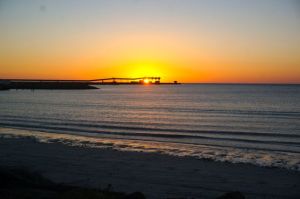
Wallaroo Sunset from the Motorhome

Sunset at Wallaroo Bay from the motorhome

This morning (after a rather late start – it must have been the salt air that made us sleep in) we drove inland to the township of Kadina. Our onboard printer ran out of black ink last night and Kadina was the closest town selling office supplies. Luck was on our side and we were able to purchase replacements at our first stop.  The navigator wants to prepare a new Japanese prawn dish tonight so it was into “Woolies’ to find a supply of panko bread crumbs and coconut shred. I am sure the dish will go very well with either a Pinot Gris or a rum and coke.

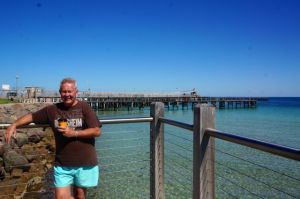
Rod at Moonta

At the Moonta pier on Monday afternoon

After the shopping we had a roadside lunch then drove onto Moonta, our stopover for tonight.

Moonta’s origins in 1861 were very fortunate – a shepherd noticed traces of copper on a wombat burrow, which led to the establishment of the Moonta Mining Company that soon became one of the richest copper mines in Australia. The ensuing flood of skilled miners from Cornwall in England changed South Australia’s cultural mix. Apart from contributing to an economic explosion, the immigrants brought Cornish architecture and the delicious Cornish pasties. The area is sometimes known as “little Cornwall”.

It is 4pm in the afternoon, we’re parked up at Port Hughes about 5 km out of Moonta and we are twenty metres from white sand and the ocean on a 30C day.  You cannot ask for much more than that on a Monday.

The Peninsula hasn’t disappointed thus far.

Categories: Uncategorized | 1 Comment

Create a free website or blog at WordPress.com.