Appreciating Albany

Our last day in Denmark on Tuesday was a very ‘kiwi’ affair. During the course of the day we meet three other kiwi couples in the same camp who were also travelling Australia in their respective motorhomes. They hailed from the Hawkes Bay, Greymouth and New Plymouth and while some had been on the road longer than others, everyone was on the same journey. We had a very social 5 o’clockers and caught up on each others travelling tales.
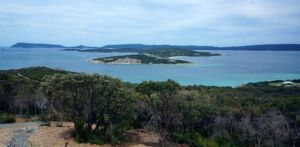
The stunning Albany Harbour

The stunning Albany Harbour

Wednesday morning we were back on the South Coast Highway and making our way the 55km to Albany. Albany was settled in 1826 and has one of the best natural harbours in the world. One of the New Zealand couples we met in Denmark currently manage the Emu Point Holiday Park in Albany so no second guessing on where our home is at the moment. It is a great little park with the ‘best possible rates’ and we are here until Monday.

We have been asked a number of times over the past weeks whether, as Kiwi’s, we were going to attend last weekends ANZAC celebrations at Albany. While we would have liked to, when we found out what the cost of staying in Albany for that weekend was going to be, we gave it a miss. The price of campsites rose from $30 per night to well over $50 per night and in some cases up to $70 per night. The price of food and the cost of eating out rose considerably. Hotels, motels and guesthouses were all charging premium prices. We were told when we arrived here on Wednesday that possibly, as a result of the pricing, the expected 70,000 attendees ended up only 40,000 and the best business day was last Wednesday i.e. the first day of the celebrations. Attendees stopped spending after that. Here is our slant on it – if there had been no price changes, the event may have attracted the 70,000 and those visitors would have had more discretionary cash to spread around the community. Talk about cutting off your nose to spite your face!

Having said all that, we are in Albany and loving it. On Thursday morning we visited the recently opened National ANZAC Centre in the Albany Heritage Park. What a stunning place. The Centre is Australia’s foremost museum to the ANZACs of the First World War and has many thought provoking images, rare film, artefacts and interactive displays. While war is nothing to celebrate and achieves little other than to stroke political ego’s, you cannot help but admire the courage of the young men who sacrificed their lives in the most inhospitable places and in the worse possible conditions. They must have been terrified as their ‘great adventure’ turned into a hell.
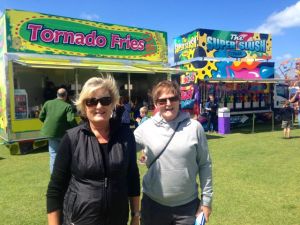
The two sisters at the Albany A and P Show

The two sisters at the Albany A and P Show

During the afternoon we did a drive around the town to get our bearings. We found it very easy as most everything is either on the Main Albany Highway or just off it. On our way back to the motorhome, the Captain did a quick recce to Oyster Harbour with the goal of picking up a dozen oysters. However when informed the price was $20 per dozen, his money went back into the pocket. It was only a 100km away that he was paying $10 per dozen.

The Navigator’s sister (Nicky) drove down from Perth yesterday afternoon to spend a few days with us in Albany. It was great to see her again and with all the excitement, we had to start 5 o’clockers at 3 o’clock. It’s a tough life over here let me tell you!

Today (Friday) has been one of those ‘stay inside’ days so far. It poured down most of the night and it has been raining off and on all morning. The forecast is for clearing later in the day so if it happens that way, we will attend the local A and P Show this afternoon. We do not have a fixed plan for the rest of the weekend apart from to see as much of the area as we can and just kick back and enjoy the visit.

Have a great weekend everyone.
Categories: Uncategorized | 2 Comments

Windy Harbour, Walpole and on to Denmark, South West Australia

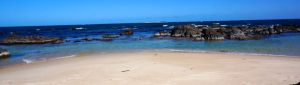
Windy Harbour Beach on a stunning day

Windy Harbour Beach on a stunning day

The journey from Northcliffe to Windy Harbour on Friday was 27km along the Windy Harbour Road. The road is bordered on one side by the D’Entrecasteaux National Park and on the other by the Boorara-Gardner National Park. Driver attention is a must as the road drops off on either side by 2 metres into deep drains or swampland. There would be no getting back onto the road if you slipped off the soft sides. We experienced another first during the short trip to Windy Harbour in that we came across a group of 12 to 15 wild emu on the road. We have seen them in ones and twos in the wild but never this many in one group. They are very skittish animals so never hung round long enough for the navigator to get a good shot.

The weather was almost perfect at Windy Harbour so we ended up by staying two nights. The Harbour is surrounded by the D’Entrecasteaux National Park and is a holiday fishing village that reveals a now rare, traditional way of life on the coast. There was no network power source, no water supply, no telephone service or cellphone service. There is one solar powered telephone box for emergencies. At a quick count there seemed to be about 50 family fishing shacks at the Harbour all with their own power supplies and water tanks. If you are heading this way do not be put off. The camping area is all grass and has good drive through sites for rigs of all sizes. They provide 230v solar power, toilets and showers if needed and all for the princely sum of $19 per night.

Dearne searching for lost treasures with her ‘gold machine’ at Windy Harbour Beach

There is a lot to do at Windy Harbour. There are four or five formal walking trails of various distances and there are always plenty of fishing opportunities. If just hanging out on the beach or swimming is your thing, then of course there is a lot of that to be done. On Friday after setting up camp we took ourselves off and did the 4km walk from Windy Harbour through Cathedral Bay to Cathedral Rock and back. This walk is along the beach and we found the going pretty tough at times. The sand was like talcum powder so with each step you sunk in above your ankles. The carrot that spurred us on was that is was going to be 5 o’clock when we got back so we were both looking forward to relaxing with a wine.

On Saturday we took a drive in the jeep and visited a number of the favourite spots in the area. Salmon Beach, about 6km from Windy Harbour is a very popular surfing beach and also famous for salmon fishing from April to June each year. There are plenty of dangers for swimmers as the beach is known for its strong ocean currents and rips. A walk along the beach was enough for us. From Salmon Beach we followed the coast in an easterly direction to Point D’Entrecasteaux. It is a cliff top location so there was no getting down to the beaches but a good opportunity to get some class shots. From the Point we made our way back to Windy Harbour and the motorhome. The plan was to have a few quiet ones with our neighbours however by the end of the day a strong cold wind off the sea drove everyone indoors and a quiet night was had by all.

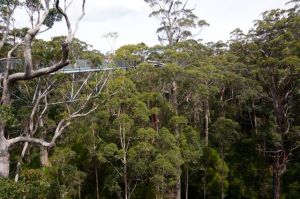
The walkway high in the canopy of the Valley of the Giants

The walkway high in the canopy of the Valley of the Giants

Sunday morning saw us departing Windy Harbour and heading east along the Western Highway toward Walpole. The journey to Walpole was approximately 120km through three stunning National Parks – Jane National Park, Shannon National Park and Walpole-Nornalup National Park where Walpole is situated. We just love the way Australian National Park roads have been built to wind their way around the trees rather than cutting them down so motorist can drive in the straight line. It makes the journey so much more relaxing and interesting. Walpole is situated on the edge of the Walpole and Nornalup Inlets Marine Park and is generally seen as a farming area. Its farming area grew out of the depression era when families were selected and sent to the area to carve farmland out of the native forests. We parked up for the night at the only camp close to the village at Rest Point and on the Walpole Inlet. For those following, the camp is 3km from the village centre, has good drive through sites and all the amenities.

The main reason for our visit to Walpole was to experience the Tree Tops Walk. The walk is in the Valley of the Giants, a forest of 400-year-old red tingle trees just east of Walpole. A 600 metre walkway is suspended 40 metres above the forest floor and weaves its way through the canopy of the forests tingle trees. The navigator struggled at the start of our walk as she is not too good with heights and the walkway ‘swayed’ as you walked along its path. We found by walking about 10 metres apart, the sway was considerably less. It was a great experience and certainly worthy of an overnight stop.

Dearne conquering the tingle tree canopy walkway

Dearne conquering the tingle tree canopy walkway

This morning we continued east along the South Coast Highway to Denmark. Denmark was first settled around 1895 with the purpose of developing a karri forest and timber industry. However the rapid depletion of the resource soon resulted in a total collapse of the industry. While some dabbled in the farming for the next 50 years, it was not until the 1960’s that Denmark became attractive to alternative life-stylers and early retirees. Intensive agriculturists such as wine growers had discovered the value of the rich karri loam for their vineyards. Riesling and Chardonnay were the first grapes grown here soon followed by other varieties. We have of course ensured we have a bottle of two of the regions fine product in the motorhome.

We are tucked into a small camp where the Demark River flows into the Wilson Inlet on the south coast. The camp has plenty of room for big rigs and has all the amenities. Our plan was to depart here tomorrow (Tuesday) and head into Albany however we have been encouraged to stay on another night by fellow travellers to take part in tomorrows Melbourne Cup celebrations in the camp. Why not – there is not too much difference between a Tuesday and a Wednesday anyway!

We have to mention the flys in this part of Australia – they are horrific. Before one goes outside, one must be adequately prepared. Any bare skin should be covered with fly repellant (they bite) and a fly net is beneficial. We had been told that wind keeps them away – rubbish!. They seem to enjoy flying with the wind to give themselves a better attacking speed. No orifice is safe!


Categories: Uncategorized | Leave a comment

Exploring the Southern Forest Region

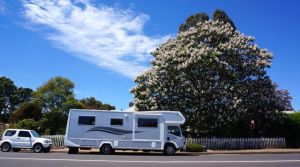
A shot of the motorhome beside a giant Paulownia tree at Nannup

A shot of the motorhome beside a giant Paulownia tree at Nannup

We really are going to have to get some sort of structure back into our lives before we head back home next year. This floating around with no plan and no time constraints might frustrate family and friends. Our journey from Augusta on Wednesday to Windy Harbour actually took us three days instead of the planned one. We kept running across little treasures in the small rural townships that required a stop.

Our first stop for the day was at the forest settlement of Nannup. Located on the banks of the Blackwood River, the village is known as the ‘Garden Village’ because of its’ hosting of an annual flower festival and a number of private gardens available to the public. We spend a couple of hours poking around the village’s curio ships and antique shops before taking a late lunch at the local park.

After lunch we continued south to the township of Manjinup. Like many other towns and villages in the area, Manjinup is also a forest and timber town. Settled in 1856, the area became famous for its jarrah wood. The wood was often called ‘Swan River Mahogany’ such was its quality. By the time we arrived in the town it was after 3pm so we decided to call it a day and made camp at the local camping ground based in the centre of town. After setting up we did a quiet wander around and by the time we arrived back at the motorhome it was wine o’clock. Another strenuous day completed.

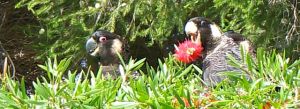
Dearne captured a shot of two black cockatoo along the street in Pemberton

Dearne captured a shot of two black cockatoo along the street in Pemberton

On Thursday we had every intention of getting to Windy Harbour by nightfall but it was not to be. After Manjinup, and 37km later, came the township of Pemberton. Pemberton is another timber town and famous for providing jarrah railway sleepers for the construction of the Trans-Australian Railway line. It also provided jarrah sleepers used in the first stage of the London Underground and a great many other railway lines in the UK. There is still a timber mill operating at the end of the main street however it seemed like the timber being milled was being used for the construction of houses rather than railway. We loved the little timber workers cottages that were spread around the town. Some were in excellent condition while others were looking a little sad. If you are considering making Pemberton your home, a little three bedroom timber workers cottage (needing a tidy up), will set you back $39,000. We spent about an hour looking around the town before heading off to our next destination, Northcliffe.

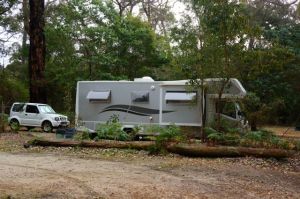
Parked up in the bush at the Rounttu-it Eco Camp

Parked up in the bush at the Roundtu-it Eco Camp

Northcliffe was 27km further on and situated in the middle of the Northcliffe Forest Park. As we were driving, the Navigator was doing a Google search on things to see in Northcliffe and she happened upon an article about an eco camp and animal rescue facility. The decision was made that the eco camp was to be our home for the night. While we love the bush and animal life over here, the captain is always a bit nervous about eco camps as they normally mean unpaved bush roads, trees of various shapes and sizes and normally directly in the driving path. A lot of skill and care is required to weave between the trees and being in hardwood country, the only thing that was ever going to bend was the motorhome. We did the wise thing and before driving to our allocated spot in the forest we walked the route to ensure we were able get through the trees. We made the journey in and out without damage.

Even checking into the Eco Park was a novelty. To get into the office, you firstly had to step over a sleeping kangaroo. With joey in pouch, it did not move an inch. With the camp being an animal rescue centre, most of the wildlife had no fear of humans albeit they were still in their natural environment. Kangaroo, wallaby, parrots and numerous other animals wandered around at will. We had to keep the motorhome security door closed because the magpies would come inside to be feed. The park is also a recognised alpaca rescue centre so there were plenty of those critters around. We had a brilliant over nighter there – if you are in the area and feel like a relaxing night in the bush with rescued wildlife, pop into the Roundtu-it Eco Park at Northcliffe.

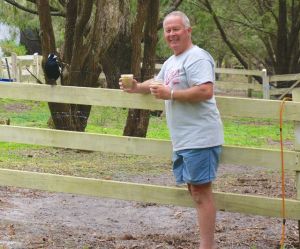
A friendly magpie intend on sharing the captain's coffee at the Eco park

A friendly magpie intend on sharing the captain’s coffee at the Eco park

We will definately make Windy Harbour today (Friday). It is only 20 minutes to the coast from Northcliffe and we leave here in about an hour.  Most of our journey is through the D’Entrecasteaux National Park so there is not too much to stop off for on the way. There is no cellphone coverage in Windy Harbour and at this point we are unsure if we will be there one or two days. If you are trying to contact us, just leave a message and we will call you as soon as we have coverage again.

We often get emails from readers asking why a number of towns and villages in Australia end in the word ‘up’. Just for your information, the Aboriginal meaning of ‘up’ in relation to place names means ‘place of’. So when you see the village of Manjimup, the Aboriginal meaning is ‘place of Manjim’. Dwellingup – ‘place of Dwelling’. Here ends the lesson.

Categories: Uncategorized | 1 Comment

Our Augusta Experience

The captain wandering around the Karri Forest - a stunning environment

The captain wandering around the Karri Forest – a stunning environment

Our journey from Margaret River on Monday was one of those Plan B days. We followed Cave Road down to Hamelin Bay, our intended over night stop, only to find we would not fit into any of the available sites. We spent about an hour or so in the Bay, had a wander around the beach then decided to carry on to Augusta.

We must mention the magnificent Boranup Karri Tree Forest we drove through on our way to Hamelin Bay. The Karri forest is at the bottom end of the Leeuwin-Naturaliste National Park and is spectacular. It is not really necessary to do the Boranup Drive thing because there are several spots along Caves Road south of Lake Cave where it is safe to pull over to the side of the road and take in the view. The Karri tree is a hardwood tree and grows to 90 metres. It is the third tallest tree in the world. Many of the karri forests in Australia’s southwest are now protected.

Now to Augusta. Augusta is the most southwesterly point of Australia. Settled in 1830, the town is situated on the banks of the Blackwood River and Hardy Inlet where it meets the Southern Ocean. We were parked up about 3km out of town in Flinders Bay and right on the edge of the Blackwood River. Once we had settled in we unhooked the jeep and took ourselves off to Cape Leeuwin, about 8 km from our parkup.

A wind blowen navigator at Cape Leeuwin

A wind blowen navigator at Cape Leeuwin

Cape Leeuwin is known for a number of ‘standouts’. Firstly, it marks the point where the Indian Ocean meet the Southern Ocean. At certain times of the year the climatic conditions and currents turn the ocean around the Cape into a washing machine. During our visit it was like a millpond! Secondly, the Cape is home to the tallest lighthouse in Western Australia and the third highest in Australia. Constructed in 1895 and standing 56 metres above sea level, the lighthouse guards one of the worlds busiest shipping lanes. Thirdly, the Cape hosts a memorial dedicated to the 10 young sailors aboard the HMAS Nizam (an N Class Destroyer) who lost their lives off the Cape on 11 February 1945. A rogue wave caused the ship to heel and 10 sailors were thrown overboard. No trace of the men was ever found. Interestingly, the Australia N Class Destroyer Association championed the construction of a memorial to the men and since its unveiling in 1993, an 11 February ceremony has become an annual event. At an N Class Destroyer Reunion in 1999, the Cape Leeuwin site was recognised as a formal Australian War Memorial. Veterans over here are accorded a tremendous amount of respect from both Central and Local Government and the Australian community.

A very impressive Jewel Cave

A very impressive Jewel Cave

Tuesday morning it was domestics and vehicle maintenance time then in the afternoon we decided we would make a visit to the limestone caves Australia is so proud of. We felt we were unable to provide an objective comparison with Waitomo unless we did the yards. The limestone ridge of the Leeuwin Naturaliste National Park hides a series of caves, many of which are open to the public. We decided to tour the ‘Jewel Cave’. The Jewel Cave is approximately one million years old and was first discovered in 1957. Hidden in the Karri forest of the Leeuwin Naturaliste Ridge and nine kilometres north of Augusta, this cave sinks to a reachable depth of 42 metres and is 1.9 kilometres long. The cave has giant formations, no natural light and while it is Western Australia’s largest tourism cave, only 40 percent has been developed for tourism. Does it compare with Waitomo? Both caves a very different so it’s hard to make a comparison. Jewel Cave is ‘dry’ while Waitomo is wet and has its rivers. We very much enjoyed both.

For those of you following us down the coast, Augusta is a great little town and there is everything here that you need. It is certainly worth considering making it your base while taking in the surrounding area.

This morning we are back on the road and plan to drive inland on the Brockman Highway to visit Nannup, then hook a right onto the Vasse Highway to lunch at Manjinup then continue south through Pemberton, Northcliffe and back to the coast to Windy Harbour. Windy Harbour (Salmon Beach) is our planned next overnight stop but nothing is set in concrete. You never know what we could come across on the way.

We are having a few cellphone coverage issues around this part of the coast so if you are calling, emailing or texting and we are not responding, you know the reason why. We will get back to you as soon as we are able.

Categories: Uncategorized | 2 Comments

Relaxing at Margaret River, WA

We were quite sad to depart the Busselton and Vasse region on Friday. It is not often we can say this but we both agreed that if our circumstances were different, we could quite easily spend a few years in the area. Oh well – always look to the future not the past.

Dearne at Cape Naturaliste Lighthouse

Dearne at Cape Naturaliste Lighthouse

As we said in the last update, we had no real plan after Vasse. However we decided on departure day to follow Caves Road around the coast rather than drive inland on the Bussel Highway. We wondered why the road was named ‘Caves Road’? After asking the courageous question, we found out that it is so named because the Margaret River region is home to over 100 huge limestone caves nestled in the spine of the Leeuwin-Naturaliste Ridge. Apparently some Australians say they compete with our Waitomo Caves but we will let you know if we go through one.

Our first stop on Friday morning was at Dunsborough. Dunsborough is a little village sheltered by the waters of Geographic Bay and is an ideal family holiday spot because of its quiet coves, sandy beaches and the surrounding national park. We had a quick look around the town before making our way to Cape Naturaliste. Cape Naturaliste is 13kms from Dunnsborough and is home to the famous Cape Naturaliste Lighthouse. The lighthouse was constructed on 1903 and was automated in 1978. The last lighthouse keeper left in 1996 and this was a last manned lighthouse in Western Australia. For the seafarers amongst you, the light’s white beam is visible for 25 nautical miles (46 km) and identifies itself by flashing twice every 10 seconds with a 2.5 and 7.5 second interval. There are supposed to be whale watching opportunities on the bluff at this time of year but we saw nothing  during our visit.

From the lighthouse we retraced our steps to Dunsborough, hooked a right and continued down the coast on Caves Road. The next village we popped into was Yallingup. This little village is a popular tourist destination because of its beaches, its limestone caves, in particular the Ngilgi Cave and its proximity to the Leeuwin-Naturaliste National Park. Unfortunately we were not able to stop there as the village is perched on the side of a hill and it has very narrow roads. We could not find a space big enough to park the motorhome.

From Yallingup we continued south with the goal of making Gracetown our home for the night. The distance to travel was only about 30km however neither of us were giving the journey as much concentration as we should have been and we shot straight passed the turnoff. By the time we realised our faux pas we were several km’s passed the turn off and we could not find anywhere to turn around. Rather than retrace our steps we decided to carry on to Margaret River.

Rod with his paddle sample at the Cheeky Monkey Brewery

Rod with his paddle sample at the Cheeky Monkey Brewery

The township of Margaret River is situated on the banks of the Margaret River and is approximately 10km from the coast. We expected the river to be quite big but with the locals calling it ‘Maggie Creek’ you can have a guess how big it really is – about the size of a creek. The town sits in the heart of the State’s largest premium wine producing region. We had completely forgotten that this weekend is the Cape to Cape Cross Country Bike Race and this race is centred around the Margaret River Region. Consequently there was no accommodation or parking facilities to be had for love nor money. After a little bit of research by the Navigator, we found a place to rest on a working sheep station about 11km outside of town. Our campsite is in a valley hidden from the outside world by a State Forest. We have power, water and plenty of space. There are about a dozen other motorhomes and/or caravans here so it is quite social.

Saturday we were plagued by rain so we unhooked the jeep and drove into town to have a look around and to visit the local Saturday Farmers Market. Goodness those places are expensive!! $6 for a small pottle of tomato relish and $5 for a medium coffee. Not much money seemed to be changing hands and accordingly very little left our pockets. We are not sure why they would want to charge so much for produce at a Farmers Market. It seems to us to defeat the intent of a market i.e. local produce from the back of a truck and cheaper because there a few overheads.

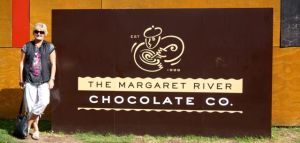
Dearne at the Margaret River Chocolate Factory

Dearne at the Margaret River Chocolate Factory

This morning we took ourselves off on the one of the local wine trail tours. It seemed to us to be a good way to have a look around the region and partake in a few wines without the worry of driving. The transport picked us up at the sheep station at about 10am and delivered us back to the motorhome at 6pm. Did you know that the Margaret River region has 150 wineries and 9 boutique breweries. During our day we visited three wineries –Watershed Wines, Nottinghill Estate and Killerby Wines, one botique brewery – Cheeky Monkey, the Margaret River Venison Farm, the Margaret River Nougat Company, Margaret River Cheese Factory and the Margaret River Chocolate Factory. Little purchases were made at each stop as you would expect. The visits were spread all around the region so over the day we were given a great look around. The price of the tour included all meals and wine so with being fed and watered all day, no dinner is required tonight.

Tomorrow (Monday) we will make our way back onto Caves Road and continue south. All going well our base for the next few nights is going to be Hamelin Bay on the coast in the Leeuwin-Naturaliste National Park. The navigator is a bit concerned that our size means we may not fit in but we will give it our best shot.

Categories: Uncategorized | Leave a comment

Back on the West Coast and near Vasse

A blossom tree in Bridgetowns main street 'dressed' with a knitted cover. Very arty.

A blossom tree in Bridgetowns main street ‘dressed’ with a knitted cover. Very arty.

We awoke Monday morning to a decidedly better day. The rain had stopped overnight and the winds had abated just a bit. Our first work of the day was to clean up the motorhome and the jeep. They had both become slightly mucky after the weekend of bad weather.

Our visit to Bridgetown did not disappoint. Bridgetown is in the Shire of Bridgetown-Greenbush and the centre of a productive agricultural district. Many buildings in the town centre are over a century old and have been beautifully maintained or restored. The area was previously known as Geegelup “the place of spears” until Bridgetown was gazetted in 1868. The town was named after the ship Bridgetown, the first ship to put into Bunbury to uplift wool from Geegelup area.

To put Bridgetown in a basket, we saw it as a boutique town. Lovely cafes, antique shops, chic” fashion stores, specialty stores, jazz and food festivals, From the late 1970s, the area became increasingly attractive as a peaceful and picturesque country town an accessible distance from Perth. Some people, attracted by the rural lifestyle on offer, sought to move to the town permanently, and this resulted in a strong demand for residential sections and hobby farms. Many of the farmers sold up and their land was subdivided. The locals call these newcomers “urban refugees”. The ‘newcomers’ have slowly turned this rural town into the type of town they sought to escape from. Funny that!

The navigator posing on our Blackwood River walk

The navigator posing on our Blackwood River walk

The are had a number of excellent walks and with us being perched on the banks of the Blackwood River, we meandered the river walk. Not overly taxing but a very pleasant few kilometres just the same. Would we recommend a visit to the town? Most certainly – it is well worth a few days here.

Tuesday morning we were back on the Western Highway and driving west toward the coast. Tuesday was also our last day in the wheatbelt. We have had a brilliant time visiting some of the small agricultural villages on our way and also having the opportunity to drive through the spectacular countryside. If there are any standouts for us it has to be the friendliness of the people and the vastness of the farms. Thousands of hectares of wheat and sheep grazing, the stands of huge ancient trees that farmers have left on their land as shelter for animals and people. The most widespread and majestic of the trees is the Salmon Gum. It grows to 25 metres high and has a massive canopy. The sandalwood tree is another favourite because of its’ fragrant timber. About a year ago while travelling inland Queensland we said we loved rural Australia. Our view has not changed.

Our first stop of the day on Tuesday was Balingup. Balingup is another one of the rural townships that have turned ‘city’. There are plenty of boutique shops, kooky wines, craft outlets and gourmet foods. We spent an hour or so wandering around the town before setting off and arriving at our second stop of the day, Donnybrook. Donnybrook is located on the banks of the Preston River and prospered during the goldrush of late 1890’s and early 1900. It is now known as the Apple Capital of the Southwest and is a giant in the fruit industry. Refreshing ciders, local wine, farm fresh marron, organic beef and rich olive oils are just some of the locally produced fare. It was midday when we arrived at Donnybrook so we decided to make it our lunch stop. Sampling some of the local produce made our meal somewhat special.

One of the many stands of salmon gum trees on the SW Wheatbelt farms

One of the many stands of salmon gum trees on the SW Wheatbelt farms

It was around 2pm when we departed Donnybrook and the next decision of the day was ‘where to next’. While we were in Bridgetown we met a couple who suggested that if we were heading down this way we should stop off at one of the church camps 10 kilometres west of Busselton at Vasse. We were advised that the camps were on the beach and relatively inexpensive. We popped the information into the GPS and off we went. When we arrived in the area we found seven campgrounds owned by churches and each had its own guidelines around the behaviours they expected from ‘tenants’. Some stated no alcohol, no smoking, no 5o’clockers, no noise but good holy fun was encouraged!! We chose the most liberal of the group – the Anglican camp.

Today is our second day here and we have no complaints. The camp is very well run, directly on the beach and no fun police. We are booked to stay here until Friday. Our plan is to see more of the Busselton area and just take in and enjoy the peaceful environment.

Categories: Uncategorized | 4 Comments

Still inland in Australia’s Southwest

First up a big thank you from the Navigator to all those who called, emailed and text her on her birthday last Friday. One of the things we really miss on our travels over here is our family and friends back home. To have most of you make contact with her on the day was a little overwhelming. A wee Pinot Gris around 5’ish seemed to settle her.

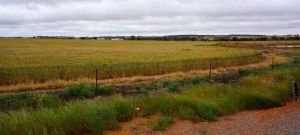
Just 20 hectares of the Belts 4 million hectares of wheat fields

Just 20 hectares of the Belts 4 million hectares of wheat fields

On leaving Stockton Lake on Friday we made our way through Southwest Australia’s Eastern Wheatbelt, over 4 million hectares of wheat production.  There are nineteen Shires (or Districts in NZ talk) within the belt and on Friday we travelled through four in the Wheatbelt South or the ‘Land of Plenty’.

Our first stop for the day was Darkan. Darkan is a town in the Shire of West Arthur with a population of about 500. The town is surrounded by a fertile soils, and a high rainfall (approx 650mm per year) which makes the area perfect for wheat and sheep. Darkan is also the social and political centre of the Shire. We love these little towns as they go all out to attract travellers such as ourselves. They offer a broad range of services to travellers that encourage us to linger and spend in their town.

The next little village we passed through was Arthur River also in the Shire of West Arthur. We had visions of the village being on a river and maybe a stopover opportunity for the night but no such luck. There was nary a river in sight with the village mainly serving as a fuel stop for travellers. In 1910 the Arthur Wool Shed Group set up a shearing shed, shearers’ quarters, sheep dip and concrete cricket pitch in the village. They appeared to us to still be the most prominent features in the town.

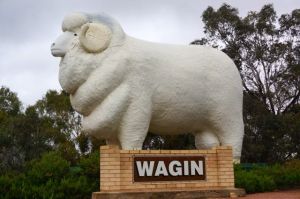
Bart, the giant ram at Wagin

Bart, the giant ram at Wagin

Our overnight stop on Friday was in the next township of Wagin (said Way-gin as we were corrected a number of times!). Wagin’s main attraction is ‘Bart” the giant ram built in 1985 to acknowledge Wagin’s prosperity in the wool industry. The Giant Ram is the second largest in the southern hemisphere and measures 15 metres in length and seven metres in height. Our parkup for the night was the local caravan park and for $20 a night there was no complaints. They provided power, water, ablution facilities, laundry and best of all great parking sites.

After a night of torrential rain on Saturday morning we continued east to the next little village of Dumbleyung. The village while a support centre for the area’s wheat and sheep industry, it is best known for Dumbleyung Lake just a few kilometres out of town. It is the largest open lake in the south west region of Western Australia being 13km in length and 6.5km wide. We were going to stop over night at the Lake but it was still bucketing down when we arrived and access to the Lake was on a dirt road so we decided to give it a miss. We have travelled enough dirt roads for a while.

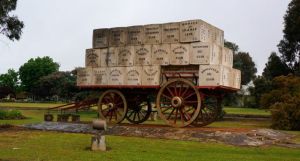
We carried on a further 70km and arrived at the village of Kojonup. The early economy of the town was initially dependent on cutting and transporting sandalwood and kangaroo hunting but by the mid-19th century the wool industry began to boom and by 1906 the Shire had 10,500 sheep. To celebrate the importance of the wool industry, the town built a one and a half scale model of a wool wagon. The surrounding areas produce wheat and other cereal crops. When we arrived into the town we decided to pop into the Information Centre to get advice on what there was to see in the area. While there, the operator told us that if we decided to stay in town overnight, they have a special RV area just across from the Centre at a cost of $5.00 per night. About the same time the captain discovered that the Bledisloe game was being transmitted on Free to Air Channel 10 which we can get in the motorhome so Kojonup became our home on Saturday night. The rain and wind persisted all night to the point that we decided to bring everything in around 10pm just in case the satellite dish and mats ended up down the road somewhere.

The giant wheat wagon at Kogonup

The giant wheat wagon at Kogonup

We were back on the road this morning with the atrocious weather continuing. We are still experiencing reasonably heavy rain and strong winds. We passed through the little village of Boyup Brook on the banks of the Blackwood River and also known as the Gateway to the Blackwood Valley. As with many of these outback villages, Sunday trading is a swear word and so consequently nothing was open therefore there was no reason to pause on our journey.

By midday we had had enough of battling the weather so decided to make the next town our overnight stop. Thirty minutes later, and fortunately for us, the next town was Bridgetown, the only heritage listed town in the southwest. Bridgetown is situated in the heart of the Blackwood River Valley and we are parked up directly beside the river. Apparently there is quite a bit to see in the town and the local area so we are here until Tuesday.

The rain and wind continues!!

Categories: Uncategorized | 1 Comment

Eastward and inland on the Coalfields Highway

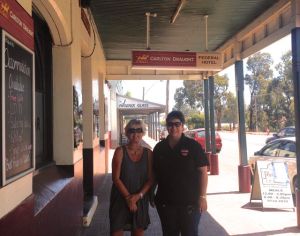
Dearne and Mereana outside the Federal Hotel in Collie

Dearne and Mereana outside the Federal Hotel in Collie

Our departure from Bunbury on Wednesday was not without incident. We were on the road by about 10am and decided to pick up a coffee from a local café before we left town. We had our ‘favourite’ place but unfortunately the only park space that was close by and would fit our total length of 13 metres was on the opposite side of the road. Undetered, the captain made a leisurely cross and parked up facing the wrong way on fairly narrow road. A few moments later a local traffic warden approached the van and expressed his displeasure at the manoevre. After some smart talking by the captain the outcome was no ticket being issued and we were allowed to remain in the parking space until our coffee was ready.

From Bunbury it was onto the Coalfields Highway and our first ‘must see’ of the day, the Wellington National Park. The Park is located midway between Bunbury and Collie with the highway running through spectacular and dense Jarrah and Marri forests. These magnificent hardwood trees make a great a sight as you drive through the Park. There are a number of excellent hiking trails and lakes in the Park so the area is much visited by people from around the region.

The motorhome tucked into the bush from across the lake on our Stockton Lake stay

The motorhome tucked into the bush from across the lake on our Stockton Lake stay

From the National Park it was on to Collie, our first stop for the day. Collie is 60km inland from Bunbury and is Western Australia’s only coal mining town. First explored in 1829, the region was originally considered ideal for timber production however the discovery of coal in 1883 it changed the regions fortunes. Prior to arriving at Collie we had been asked to make contact with a friend of our friend Brenda who is the proprietor of a local Collie hotel, The Federal. We duely did as we were told and rocked up to meet Mereana. Mereana originally hails from Browns Bay in Auckland but moved to Perth 28 years ago and her and hubby have owned The Federal for the past six years. They have a lovely little establishment and she was a great hostess. We were loaded into her car and showed around the town and the local hot spots in the area. Many thanks Mereana.

From Collie it was back on the road and a further 8km east to Stockton Lake (about the size of Lake Pupuke on Auckland’s North Shore) where we made camp. Stockton Lake, once Stockton Mine, was the region’s first open-cut mine. When the mine closed it was filled with water to form an artificial lake. The Lake, with a depth of 32 metres, is now used for all type of water sport activity including diving. We were told that the place goes quite feral on weekends as it is a favourite camping haunt for local youth. Our two night stay at the Lake was during the week so it was peaceful and quiet.

The Navigator's birthday brekkie

The Navigators birthday with breakfast in bed

Today (Friday) is a special day as it is the navigator’s birthday. Being out in the middle of nowhere made it a little difficult to ‘pop out’ for a birthday breaky however she was treated to an ‘in bed’ breakfast of poached eggs on toasted muffins accompanied by free range bacon, a medley of peppers, pink Himalayan salt and hot Nepresso coffee. It was not the Hilton but the best the captain could do in the middle of the bush. After breakfast it was a slow pack up and we were back on the road before the weekend revellers started to arrive at the Lake.

It is midday and we are back on the Coalfields Highway making our way toward Wagin. We are undecided where we will stop for the night but are hoping to find somewhere like the Stockton Lake. The big issue for the captain today is that he is trying to find somewhere where he can watch the Bledisloe Cup tomorrow. It is AFL country here with rugby being the very poor cousin and so games rarely feature in any of the hotels or clubs.

Categories: Uncategorized | Leave a comment

Perth, Dwellingup and Bunbury

The last two days in Perth were sombre affairs. On Friday night we bid farewell to grandsons #1,2 and 3 who returned to New Zealand to start the new school term. A few tears were shed by all at the departure gate and we are sure they would have stayed on if the opportunity was available. Still, they had a great holiday with us in the motorhome and there will be many more when we are back home next year.

Saturday night we attended a farewell bbq at the home of daughter Tiffany and partner Charles. This was the last opportunity to catch up with them before we left Perth on Sunday. It was a sad night in a way as baby Mia was now recognising us and Caleb loved having us around. Son Josh and his lady Tarsh also came along to make it a Western Australia whanau event.

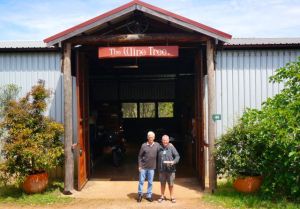
Rod with Greg at The Wine Tree in Dwellingup

Rod with Greg at The Wine Tree in Dwellingup

We departed Perth on Sunday morning and made our way south passing by Kwinana, Fremantle, Rockingham and Mandura (we have visited all these places in the past so saw no reason to stop) before hooking a left and making our way inland to the tiny settlement of Dwellingup. The Dwellingup area was born in 1896 as a result of a developing forestry and milling industry. It was established as a town in 1910 when it became the administration centre for local rail, medical and other forestry support services. Dwellingup will always be remembered ‘as the little town that was wiped out in 1961 by a major bush fire’. While there was no loss of life, the majority of the township was burned to the ground.

The main reason for our visit to Dwellingup was to catch up with our mate Greg Caswell who owns the very popular winery ‘The Wine Tree’ just out of the village. He produces a top quality range of ciders, wines and ginger beers and has a constant flow of visitors and patrons on most days. It was great to catch up with Greg again and to see his business flourishing. Many thanks for your hospitality Greg and we look forward to your visit to Whangamata next year.

We left Dwellingup around mid afternoon on Sunday and made our way back to the coast and onto the city of Bunbury. Bunbury’s first settlers arrived in 1838 but it was not until the Donnybrook goldrush in 1897 that the small colonial outpost became a town. We had heard nice things about the Bunbury area so we decided to make it our home for three days. We have been parked up at Koombana Bay just a 10 minute stroll from the city centre and a 2 minute stroll to Koombana beach. The weather has been very kind to us with 26C days and down to 12C nights. Good for this time of the year.

Koombana Bay in Bunbury, WA

Koombana Bay in Bunbury, WA

Bunbury is one of those towns where you can walk or cycle everywhere. It is very flat and not too far to anywhere. We managed to get around most of the town and enjoy what has to offer. The standout for us was the number of restaurants and café’s in the town. There was any and every type of food available. There also seemed to be an abundance of beauty salons and hair dressing salons. We are not sure if there is a link between food and beauty here but we are sure that if challenged, we could make something up.

We made a visit to the Dolphin Discovery Centre in Koombana Bay. The Bay has a resident population of about 100 bottlenose dolphins who swim very close to the beach each day. While still ‘free’, they interact quite willingly with people wading in the water along the shore. A liberating experience.

We will reluctantly leave Bunbury tomorrow (Wednesday) morning and continue our journey. For those travellers reading our blog and if you are meandering south for the summer, make Bunbury one of your stopovers. It is a very relaxing parkup. Our plan tomorrow is to drive inland and do a big loop to incorporate visits to the areas many wine regions, National Parks, State Forests, rivers and dams. Just for your information there are over 40 wineries producing under their own labels operating in this area. Most offer cellar door and food facilities. Goodness it is going to be a tough few days!! Our loose plan is to be back on the coast just south of Bunbury at Capel in about 10 days time. Too much to see and so little time. We are hoping we will have reception most of the way so will update the blog when we can.

Categories: Uncategorized | Leave a comment

Our Perth visit coming to an end

Rod and old shipmates George Randell and Miles Haliburton catching up in Perth

We have had a number of emails over the past few days wondering if we had dropped off the face of the earth as there have been no blog updates. While there can be no excuses, we have to say our Perth layover has been very social. With having friends popping in to see us plus having grandchildren staying with us, by the end of each day the last thing we have wanted to do is to get the laptop out to update the blog. We are positive it is not our age showing but the grandchildren seeming to have much more energy and requiring more of our attention.

Rod returned to New Zealand early last week and brought the three oldest grandchildren back with him. The navigator was most relieved last Wednesday night when he arrived back at Perth airport with all the children in tow and in good health. There was no luggage, ipads or camera’s lost. To be honest, the captain looked slightly jaded but a relieved man there was no disaster on his watch.

After a couple of days of acclimatisation in Perth, and with a full day last Thursday at the Perth Royal Show, on Friday we loaded four grandchildren and ‘Auntie Nicky’ into the motorhome and made our way 220km south to the town of Busselton. The original plan was to stay at Bunbury and attend the annual Kids Festival but unfortunately it was cancelled at the last minute so we felt Busselton, voted Western Australia’s top tourist town in 1995, 1996 and 2005 was probably the next best thing. We made our home for two nights in Busselton at a local beachside holiday park. The kids absolutley loved it. The Park had a great playground, sports field, games room and pool complex and with it being school holidays over here there was no end of children of all ages for them to interact with.

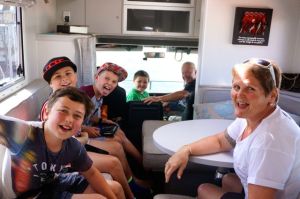
In the motorhome and heading off to Busselton. L to R Grandsons Hunter, Jayden, Jeshua, Caleb, the Captain, Auntie Nicky

Busselton is home to the longest wooden jetty in the Southern Hemisphere stretching almost 2km out to sea. Construction of the jetty began in 1853 and was continually extended until the 1960s when it reached its current length of 1841 metres. It was closed to shipping in 1972, and maintenance was discontinued for a time. It has since been restored, and is now the site of an underwater observatory and an interpretive centre. The plan was that we would catch the small train that ran along the jetty from the shore to the very end and back. Unfortunately the train was booked until 3pm so Nana and Poppa made the decision that we would all walk it – much to everyone else’s consternation. However with the promise of a ‘fish and chip’ lunch when we got back to shore, the 3.5km ‘stroll’ was made without ‘hardly’ any issues.

On Sunday morning and in the pouring rain, we packed up camp and made our way back to Perth again. In Perth we have made our home in a Park that is set up for kids. It has great play areas, heated pools and lots of other children to play with. This makes our lives so much easier. We spent today at the Caversham Wildlife Park. Kiwi kids normally have very little opportunity to interact personally with kangaroos, wallaby, snakes, lizards, wombats and a huge variety of birds. This wildlife park has it all. Wandering among the wildlife with no fencing between the kids and the animals was super exciting for them. They were fizzing at the end of the day.

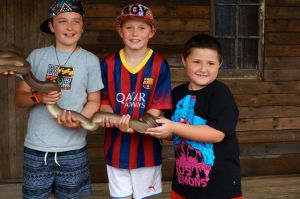
The snake handlers

The snake charmers at Caversham Wildlife Park. L to R Grandsons Hunter, Jeshua and Caleb

So where to from here? We still have a couple more days with the grandkids before they fly back to New Zealand on Friday evening. We have a very busy programme for them over the last few days so sleeping should come easy for them, and us, at the end of each day. We will let you know how things panned out in the next update. After they depart we will remain in Perth until Sunday. We plan to visit the Wildflower Festival in Perth on Saturday and will use what is left of the day to replenish our stocks and generally get the motorhome ready for the next three months of our journey in the southwest quarter of Western Australia. We are not quite sure at this point where we will end up on Sunday night but it is our intention to visit a friend who has a fruit winery in Dwellingup so we will see what happens from there.

We are back into the ‘no plan’ mode. Our next firm appointment is Christmas time in Adelaide.

Categories: Uncategorized | 1 Comment

Create a free website or blog at WordPress.com.