Arrived Perth

The Pinnacles in the Nambung National Park, Western Australia

The Pinnacles in the Nambung National Park, Western Australia

Twenty kilometres after leaving Cervantes on Thursday morning we hooked a left off the Indian Ocean Drive and into the Nambung National Park. While the Park is fringed with stunning beaches such as Kangaroo Point (so called because mobs of kangaroos gather at the beach at dawn and dusk) and Hangover Bay, our visit was to see the Pinnacles Desert.

Ancient limestone pillars scattered across the desert in their thousands create an eerie, lunar-like landscape. Some are as high as three and half metres and finish in a jagged point. Others have rounded domes resembling tombstones. There are several theories as to how the pillars evolved. Some say they are the calcified remains of trunks from a petrified forest buried by sand in a period of intense storms. Others say they are made up of shells, sand and limestone and date back millions of years to a period when the desert sand was beneath the sea. Whatever the story, we found the phenomenon very impressive and worth the deviation from the highway.

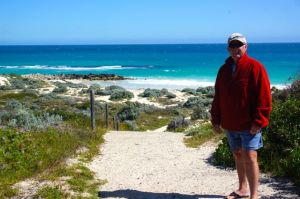
Dearne at the Pinnacles

Dearne at the Pinnacles

On leaving the National Park we made our way to Yanchep, 56km north of Perth and our home for the two nights. While the days were fine during our visit, we had very cold winds so relaxing on the beach was out of the question. Yanchep is another town with a very interesting history. Once a sheep farming area and a small crayfishing village, in 1970 entrepreneur Alan Bond bought approximately 8100 hectares of the surrounding land for the 1977 America’s Cup and his vision for the development of ‘Yanchep Sun City’. However we all know what happened to many of the ‘financial visionaries’ of the 70’s and Bond Corporation was just another. While Yanchep is growing, it is a million miles away from the 70’s prediction of 200,000 by the year 2000.

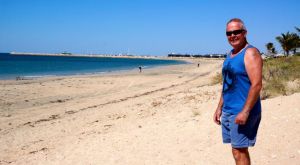
Rod enjoying Yanchep Beach in the cold

Rod enjoying Yanchep Beach in the cold

Friday morning we departed Yanchep and made our way into Perth. Perth is going to be our home for the next two weeks as we have family here and will spend time catching up. We are also bringing the three oldest grandsons across from New Zealand to Perth next weekend so they can travel with us for a time. We are not sure where our stops are going to be but we are sure the boys will not mind as long as they are with us and are in the motorhome.

On a final note in this update, we were very lucky last night and were able to get TV coverage of  election night through TV1 with the help of ABC. Suffice to say we are both ecstatic with the result and feel MMP has come of age in New Zealand. There seems to be a far better understanding of the two types of vote. We are both praying that the 5 percent thresh hold does not change. There are enough loonies there already without adding to the pot.

Categories: Uncategorized | 3 Comments

The Pinnacles Countryside Tour, New Norcia and back to Cervantes

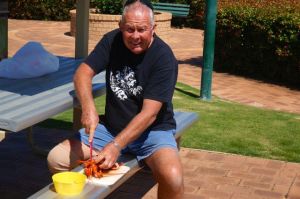
Rod preparing our crayfish lunch at Moora

Rod preparing our crayfish lunch at Moora

On Sunday morning we bid farewell to Steve and Jane as they made their way toward Perth to ready themselves for their return to New Zealand for the summer. We also continued south only to pause 30km later at Cervantes. As we were taking a quick look, we came across a crayfish processing factory with a shop and restaurant attached. For the princely sum of $20 we were able to purchase a reasonably good-sized crayfish. Crayfish in hand, and because it was still so early in the day, we decided to carry on to New Norcia for the night and return to Cervantes on Monday for a couple of nights.

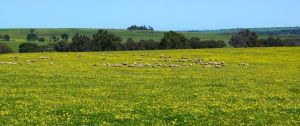
The navigator planned the route and decided we would tour the Pinnacles countryside on the way to New Norcia. It was a stunning journey through wheat fields, wildflowers, canola crops and sheep and cattle country. Again the climate made a huge difference to the vista. The area has had a bit of rain, it is green and the crops are flourishing. We stopped for an hour or so at the township of Moora for a bit of lunch (crayfish) and had a wander around the town then continued on to New Norcia.

The attraction and the fame of New Norcia is that it is the only monastic town in Australia. It is situated 130km north of Perth and on the banks of the Moore River. The New Norcia Benedictine Community is the official title of the group of Roman Catholic monks who have owned and operated the small town of New Norcia since 1847. The monastery has ownership of a little over 8000 hectares surrounding the monastery and the nine monks in residence manage its business. The monastery employs just over 60 staff in a variety of roles and its primary income is derived from cropping and the 10,000 head of sheep on the property.

The stunning wildflowers seen in our drive to New Norcia

The stunning wildflowers seen in our drive to New Norcia

We arrived just in time on Sunday afternoon to undertake a formal tour of the town and the monastery. The town’s building are in a Spanish style of architecture and the historical sites including two old boarding schools, an old mill, a wine press, a hotel (still operating), and the monastery itself. Our tour guide had worked in the town for 40 years so was able to provide us with a great history. We parked up for the night in a field next to the monastery itself.

Monday morning it was back on the road to complete the navigator’s loop of the Pinnacles countryside. We headed southeast to the small country town of GinGin for morning tea then travelled north through Dandaragan and onto the Emu Downs Wind farm for lunch. We are not really into wind farms but just so as you know we were paying attention the wind farm has 48 turbines, produces 80 megawatts, supplies 50,000 homes and only requires 7 people to operate and maintain the farm.

After lunch it was onto Cervantes. The total distance of the navigator’s Pinnacles countryside tour was approximately 250km. While New Norcia was our ‘must see’, the rest of the tour enabled us to visit a number of other small country communities we would not have otherwise seen.

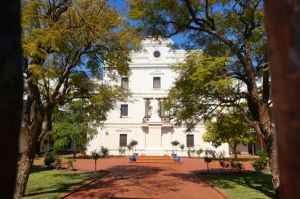
The monastery itself at New Norcia

The monastery itself at New Norcia

Cervantes has been our home for two nights. The village has a population of about 450 and is a laid back fishing settlement about 198 kilometres northwest of Perth. Our park up was the local caravan park approximately 50 metres from the waters edge and with a great view of the towns fishing fleet tied up on buoys about 100 metres from the shore.

We can already attest to the quality of the crayfish and we can now confirm the marinated octopus is delicious. The Indian Ocean Rock Lobster Factory and its associated restaurant “The Lobster Shack” is directly on the beach and they have a broad range of fish products available. They also allow self-guided tours of their factory where one can see how the lobster gets from the ocean to the dinner plate. We have spent a bit of time at the Lobster Shack!!

We are reluctantly departing Cervantes tomorrow and continuing toward Perth. The goal is to make Yanchep by tomorrow night.

Categories: Uncategorized | 2 Comments

Geraldton, Jurien Bay and onto Cervantes

A good shot of the Pink Lake at Port Gregory

A good shot of the Pink Lake at Port Gregory

We know we have said this before but in Australia, and over the matter of a few hundred kilometres, the appearance of the countryside can change considerably. The journey from Kilbarri to Geraldton on Monday further emphasised how the different climatic conditions impacts on this west coast. We went from dry tussock cattle country to relatively green sheep and agricultural country over a very short distance. Being a farmer over here would not be easy.

About half way between Kilbarri and Geraldton we passed the Port Gregory Pink Lake. Like many of its kind in Western Australia, the lake’s pink colouring is created by bacteria which becomes trapped in the salt granules. They say that the lake is best viewed at sundown but we thought the shot we got on Monday morning fairly represented what the lake looked like.

We arrived in Geraldton on Monday in light showers and the weather did really not improve much over the three days we were there. It was certainly not beach weather but it was a nice relaxing stay anyway. The town reminded us very much of Napier and New Plymouth. With a population of about 35,000, the city is home to the Port of Geraldton, a major west coast seaport.

Rod at the HMAS Sydney Memorial at Geraldton

Rod at the HMAS Sydney Memorial at Geraldton

Tuesday was a cleaning and maintenance day on the motorhome and jeep. Not that there was too much wrong with either but just being in one place for three days, having access to water and having good retail support, more of the necessities were available. We celebrated the end of a busy day with a dinner out with Steve and Jane at a local restaurant.

On Wednesday afternoon we made a visit to the memorial for the World War II cruiser HMAS Sydney. It is located near the centre of Geraldton on top of nearby Mount Scott. The memorial recognises the loss of the light cruiser during a sea battle with the German auxiliary cruiser Kormoran off Shark Bay on Australia’s West coast in November 1941. None of the 645 sailors aboard survived the battle. The location of the sunken vessel had been a mystery for 66 years until it was found in March 2008. I cannot help wondering how a ship like that could lose all men. The dome of the memorial is made up of 645 stainless steel seagulls – one for each sailor lost. A granite wall listing the names of the ship’s company who perished is a reminder of the needless destruction of war.

We left Geraldton on Thursday morning and meandered the 200km south to Jurien Bay. As we drove down the coast we hooked a right off the main highway and made a visit to the small coastal town of Port Dennison. Port Denison is a crayfishing town of 3000 residents in the Mid West region of Western Australia. We got chatting to a couple of employees of the local crayfishing factory who informed us the 90 percent of the region’s catch was exported ‘live’ to China. It is a great little earner for the small town. Unfortunately for us we were unable to purchase any of the product from them. Ninety eight percent of the crayfish was exported and with the live export price to China at A$68 per kilo – we decided this was outside our budget.

The beautiful Jurien Bay

The beautiful Jurien Bay

We arrived at Jurien Bay just after lunch on Thursday. The coastal town is in the wheatbelt region of Western Australia and is 220 kilometres north of Perth facing the Indian Ocean. Like Port Dennison, crayfish, also known here as the Western Rock Lobster, are abundant in the area, and the town’s development was influenced by the crayfish industry. The towns multi-million dollar industry regularly exports to to Japan and the United States.

The Jurien Bay weather was very kind to us. We had stunning warm days and fine but cool nights. We were able to get out and about and have a good look around the area. The town is experiencing a house-building boom as its popularity as a holiday destination grows. It is only a short distance from Perth which makes buying a holiday home here an attractive proposition. Very similar to Whangamata, it is claimed that the town’s population more than doubles during the holiday season. We could well imagine that we would spend quite of bit of time here if we lived on this coast.

Road and Steve heading off on an early morning ride at Jurien Bay

Rod and Steve heading off on an early morning ride at Jurien Bay

The Bay has a brilliant 7.5km cycle and walkway along the waterfront. It is concreted and passes through the main beach area and into the sand hills. One of the standouts on our rides was the reasonably large blue tongue lizards that we were coming across as they lazed on the path soaking up the sunshine. We were doing the decent thing and guiding them back into the sand before they were run over by marauding cyclists.

Tomorrow we continue our journey south as far as Cervantes. It is not that far and we are not sure at this point whether we will overnight there. It will depend on what there is to see. It will be another one of those ‘no plan’ days.

Categories: Uncategorized | 2 Comments

Last Day in Kalbarri

Murchison River Gorge from Hawkes Head in the Kalbarri National Park

Murchison River Gorge from Hawkes Head in the Kalbarri National Park

How will we remember our visit to Kalbarri? That’s easy – it has rained every day we have been here. We are not saying we did not enjoy the visit but the weather made it significantly different to the rest of our journey.

Kalbarri is found at the mouth of the Murchison River on Australia’s Coral Coast. While the coastline would appear to be the primary attraction to visitors, the real attraction for us was the Kalbarri National Park. The National Park covers an area of 186,000 hectares, encircles the town and provides two contrasting settings. East of the town are the inland river gorges and south of the town is magnificent ocean sandstone cliffs, many more than 100 metres above the ocean.

Unfortunately because of the weather, some of the roads in areas we would have liked to visit would have been a driving challenge. Rather than put any of the vehicles at risk, we decided to not to enter those parts of the National Park. We did our best but again, perhaps on another day.

Wildflowers in the Kalbarri National Park

Wildflowers in the Kalbarri National Park

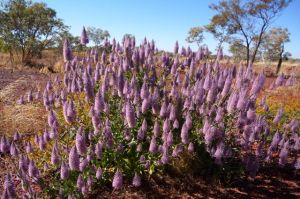
The navigator has been in heaven here. Kalbarri has over 800 species of wildflower and as we drove into the town through the National Park, on both sides of the road the wildflowers were in bloom. On Saturday we took a ride 50km west of Kalbarri and further into the National Park. The area’s sand plains enabled the Navigator to significantly add to her photographic collection of West Australia wildfires.

We were very keen yesterday to try and find a venue here where we could watch the All Black game. It really hit home that rugby is very much a minor sport over here. No hotel, club or resort had the All Black test. It was all AFL. We were able to watch Australia play South Africa on Channel Ten in the motorhome but it was not the same!!

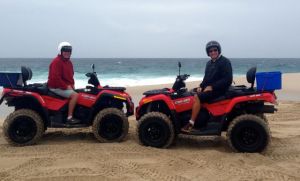
Today was Fathers Day and the captain received a call from all the children. He was very chuffed. In his view there is nothing like knowing your family love you. Everything else pales into insignificance. To top off his day we decided to do a ‘boy’ thing. 20km south of Kalbarri, one of the local coastal cattle stations run quad bike tours. We were picked up at the motorhome and taken to the station. From there it was onto the bike, over the sandhills and onto the beach. We spend a brilliant couple of hours cruising along Wagoe Beach and through the sandhills.

Rod and Steve loving the life - two absent fathers on Fathers Day.

Rod and Steve loving the life – two absent fathers on Fathers Day.

Approximately 22,000 of the world’s humpback whale population pass the Kalbarri coastline around June through to November on their migration each year. We have been keeping an eye along the coast for the past three days but again because of the weather, luck was not on our side. No whales have been sighted. We have not given up – we are driving down the coast tomorrow so will be on alert for the elusive photo shot.

Tomorrow morning it is back on the road to follow the south road through Port Gregory and onto Geraldton. Geraldton is the regional hub of Australia’s Coral Coast and hopefully its size will enable us to get a couple of repair jobs completed ready for the next stage of our journey. Our plan is to stay in Geraldton for three or four days.


Categories: Uncategorized | Leave a comment

Carnarvon, Denham, Monkey Mia, Hamelin Station and to Kalbarri

Our journey to Carnarvon on Sunday was without incident. We say that because most of the highways on this coast are unfenced so there is always the opportunity for cattle, sheep, goats or emu to be roaming the road. Over a distance of 180km on one day of last week, we counted forty-three dead cattle on the side of the road that had been hit by vehicles. No matter the time of day, driving in Australia presents a range of deadly hazards.
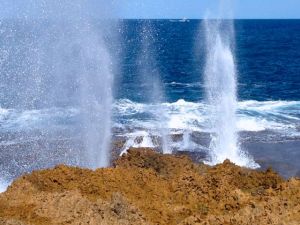
The blowholes at Point Quobba north of Carnarvon

The blowholes at Point Quobba north of Carnarvon

We are finding that the distances between our overnight stops down the west coast are normally in excess of 300km and there is very little to stop for on the way. The road to Carnarvon was no different. The countryside is made up of red earth and scrub but what broke our journey was the constant stopping to photograph wildflowers. Once we have completed the journey to Perth, and have named all the flowers, we will put them up on the blog through SmugMug.

Carnarvon is a coastal town situated approximately 900 kilometres north of Perth and lies at the mouth of the Gascoyne River. The popular Shark Bay world heritage area lies to the south of the town and the Ningaloo Reef lies to the north. One of the first things you notice in driving into the town is the thriving agricultural industry – especially the fruit and vegetable crops. This is in complete contrast to the scrub covered land surrounding the town. Carnarvon also has a thriving cattle, sheep, goat and prawn industry. The town’s is famous for its’ One Mile Jetty. Build in 1897, the jetty is one of the longest in the Southern Hemisphere.

On Monday morning we took the jeep and drove 70km north of Carnarvon to Point Quobba and the blowholes. The blowholes form a natural spectacle as the ocean is forced through sea caves before exploding out through holes in the rocks. During our visit, the seawater being forced through the holes was reaching at least 20 metres in height. A sobering part of our visit to the blowholes was the number of memorial plaques fixed to the rocks in the area where fishermen had drowned while participating in their passion. It stuns us how people are willing to die for a fish!!
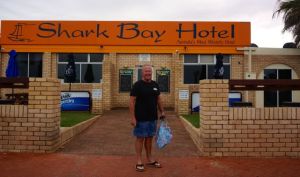
Rod at Denham visiting the most western pub in Australia

Rod at Denham visiting the most western pub in Australia

On Tuesday morning it was back onto the North West Highway and toward Denham. On our way we made a brief stop at Shell Beach. The beach is close to Nanga Bay and 45km southeast of Denham. Shell Beach is so called because of the natural water phenomom that allows the tiny cockle or Coquine to grow. Trillions of tiny shells have accumulated up to 10 metres deep and 1km wide to form a beach made of shells stretching 120km.

Denham consists of a small main street, a population of 600, is the western most town in Australia and is located on the beach on the west coast of the Peron Peninsula 831km north of Perth. It is a stunning part of the coast with an equally stunning beach. We found a great spot at a local park and spent a couple of days in the town. We also caught up with our Waiheke Island travelling companions, Steve and Jane, in Denham. They left us in Broome and had been making their way slowly down the west coast. They are now on the last part of this leg of their Australian journey as they fly home to NZ on 1 October to spend summer on Waiheke.

A dolphin swimming along the beach at Monkey Mia

A dolphin swimming along the beach at Monkey Mia

On Wednesday we took a short drive to Monkey Mia. Monkey Mia is located 23km northeast of Denham and its main attraction is the bottlenose dolphin population that play along its’ shore. Generations of dolphin have been coming close to beach for more than fifty years and while still ‘wild’, they have no hesitation in being within a metre or so from the beach and the people standing in the water. It was a truly brilliant experience and only topped off by a male emu and his chick walking around the beach while we were there. Again the Australian wildlife is fantastic. We would have loved to spend some time in the Francois Peron National Park at the northern tip of the Peron Peninsula but unfortunately a 4WD with a high clearance was considered necessary to make a visit and the little jeep would not have passed the test. Maybe another day.

There was big excitement on Wednesday. There were clouds in the sky and rain. We haven’t had any clouds or rain since our visit to Coober Pedy in very early June this year. It wasn’t a big fall but enough to wash a bit of dust off the motorhome and jeep and to dampen down the roads. By lunchtime it was back to blue sky and no rain.

On Thursday morning we departed the Peninsula and drove 130km south to Hamelin Station where we had decided to stay the night. Hamelin Station was first settled in the 1870’s and consists of 200,000 hectares of grazing land. The station farms 20,000 sheep and 5, 000 goats. We arrived about midday and once set up we unhooked the jeep and made a visit to the Hamelin Pool Telegraph station on the Hamelin Pool Marine Reserve. The Telegraph Station was built in 1884 on the Perth to Roebourne telegraph line. The original building is now a historic museum and well worth a look.

Close by the Telegraph Station is an old shell block quarry. In days past the quarry provided compacted shell blocks for use in building station homesteads, civic buildings and landmark buildings in Denham. The quarry still provides blocks for repairs on existing shell block structures but the block is no longer used on new buildings. Interestingly, the Hamelin Station homestead is made of shell blocks. The compacted shell blocks were cut from the quarry with a chainsaw.

A great shot by the Navigator of the stromatolites underwater at Hamelin Pool Marine Park

A great shot by the Navigator of the stromatolites underwater at Hamelin Pool Marine Park

Have you ever heard of stromatolites? We certainly hadn’t until our visit to Hamelin Pool Marine Reserve. Here goes our explanation and remember we are not scientists. The stromatolites – literally layered rocks – are the oldest form of life on earth dating back 3000 million years. The warm shallow waters at the southern end of Hamelin Pool Marine Reserve favour the growth of microorganisms, particularly cyanobacteria, the simplest single-cell life form known. Stromatolites are the result of cyanobacteria trapping fine sediment and because the cyanobacteria need sunlight to grow, they have the ability to move toward the light thus their growth keep pace with the accumulating sediment. A viewing walkway provided excellent access to stromatolites in the Hamelin Pool area. Take from that what you will!!

This morning we departed Hamelin Station and made our way 270km to Kalbarri. Kalbarri is a coastal town located 592 km north of Perth and is found at the mouth of the Murchison River. There is quite a bit to see and do here so this will be our home for the next three days.

Categories: Uncategorized | 1 Comment

Around the Exmouth Gulf

Our overnighter at the Port Hedland Golf Club was very pleasant. While the car park was red dirt, the Club’s hospitality was brilliant. The bar staff, all Kiwi’s from Kaitaia, gave us keys to the Clubhouse so we could access the toilets and bathroom after hours, they provided us with free WiFi and access to the Clubs bar facility. If we were going back that way again, we would certainly pop in. Many thanks guys.

Wildflowers on Australia's west coast

The start of Dearne’s wildflower photographic collection

Monday morning we drove back onto the North West Coastal Highway and made our way south. Our first stop for the day was at a little village called Roebourne. Roebourne is 200 km south of Port Headland and is a former goldrush town in Western Australia Pilbara region. While there is not too much to see, the town’s effort to restore their original town buildings to give an insight into the early pioneer times is worthy of the stop.

One of the navigator’s projects on this part of our journey is to photograph as many of the West Coast wildflowers that she can find. The area has 12,000 species of the flowering plants but there are 224 of them that we are likely to see as we travel along the highways. Flowering normally occurs between June and October so we are in the area at the best time.

Our next stop after Roebourne was 40km further on at the town of Karratha. Karratha is the town adjoining the port of Dampier in the Pilbara region and was developed in the 1960’s to house the processing and exportation workers of the Hammersley Iron Mining Company. In the 1980’s the town grew even further with the influx of workers from the North West Shelf Venture petroleum and liquefied gas operations.

The Navigator resting at Coral Bay

Dearne relaxing at the beach at Coral Bay

The size of the town took us by surprise. We thought it was going to be quite small when in fact it ‘relatively’ large with a population of around 17,000. It has a modern shopping complex, some very new apartment complexes directly on the water and plenty of green gardens and lawns. We were hoping to catch up with Tunui while we were there but unfortunately he was back in New Zealand with his ‘new bride’. We made time to take a quick lunch in the town then carried on south. By this time it was around 3pm in the afternoon so we drove another 150km and spent the night at the Robe River Rest Area. It was nothing flash but it was free, flat, safe and a good nights stop.

On Tuesday morning the original plan was to drive directly to Exmouth but unfortunately we had under estimated the distance to travel against our fuel remaining (the Captain has taken responsibility for the error). Rather than create an embarrassing situation and get ourselves stranded on the side of the road, we did a wee divert (110km) to the Manilya River Roadhouse, fuelled up then made our way up the Manilya Exmouth Road as far a Coral Bay. That was us for the day – in fact that was us for two days.

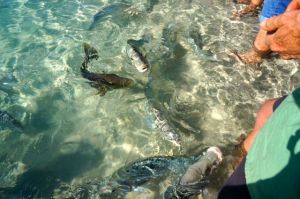
Coral Bay is a small settlement that lies protected from the Indian Ocean by the Ningaloo reef. It is Australia’s only fringing reef where the coral starts right at the waters edge. While there was heaps of ‘tourist’ opportunity here in the form of glass bottom boats that will take you out to the main reef itself, because the coral starts at the beach all that is really need are a snorkel, eyepiece and fins to view tropical fish and the coral. We had luckily bought our snorkelling gear across with us so we spend a lovely Wednesday on the beach and in the water. For the fisho’s amongst you, some of the fish we saw were stunning. The huge norwest snapper were coming up to the beach and swimming around your legs. The temptation was almost toooo much!!

Oh so tempting and those Norwest Snapper are just asking to be caught

The Norwest snapper just asking to be caught!!

Thursday morning it was a reluctant goodbye to Coral Bay and onto Exmouth. The town is at the tip of the North West Cape in Western Australia and 1200km north of Perth. Of interest to the Captain was that Exmouth was established in 1967 to support the nearby US Naval Communications Station Harold E Holt. On Friday morning we took a drive just north of Exmouth to the station to have a look around. Obviously security is very tight so going inside was out of the question but with the station being situated directly beside the road so it was relatively easy to identify what part was what. The aerial farms are massive and take up much of the areas ‘spare land’. We were told that the location was first used as a military base in World War II.

On Friday afternoon we drove north and cruised around the Exmouth peninsula. Our first stop was the Viamingh Head Lighthouse. The lighthouse is on the tip of the peninsula on the highest point of land and 17km north of Exmouth. It was built in 1912 to aid in the development of marine navigation along the western coastline of Australia and as a direct result of the wrecking of the SS Mildura in 1907. We were able to get some great shots of the surrounding area.

Rod beachcombing at Exmouth's Home Beach. There's not too much work being done looking at that tan

Rod beachcombing at Exmouth’s Home Beach. There’s not too much work being done looking at that tan

On leaving the lighthouse we carried on a further 50km down the eastern side of the peninsula to our intended destination, Turquoise Bay. Turquoise Bay is the highlight of the Cape Range National Park beaches and is a crystal clear lagoon beside the Ningaloo Reef that offers great snorkelling. We had taken our gear with us so spent a pleasant afternoon cruising around the lagoon and as close to the reef as the currents would allow. Our only regret is that we did not have an underwater camera to capture the stunning marine life we saw n the lagoon.

Today is our last day in Exmouth. The normal pre-departure domestics have been completed i.e. we are refuelled, topped up with water, LPG, groceries and both vehicles thoroughly checked. We still managed to explore more of the coastline today and spend a bit of time relaxing at a local beach.

Our plan tomorrow is to drive to 370km south to Carnavon and spend a next couple of days there. There a one or two ‘must sees’ in that area and we think two days should do it.

Categories: Uncategorized | 3 Comments

Australia Holiday Opportunity

In reading our blog you would have heard us mention our travels with an Australian couple, Bruce and Lyn, who we met at the start of our adventure while travelling Queensland. We have caught up every few months or so as our paths cross around the country. A week or so ago while we were in Broome they suggested that they would like to come to New Zealand and undertake a motorhome adventure around our country. We jumped at the chance to return their hospitality and offered to show them around.

They have asked if we could enquire whether anyone reading our blog would be interested in a motorhome exchange opportunity. The loose plan is that they would like to arrive in New Zealand between Xmas and New Year 2015 and return home mid April 2016. Bruce and Lyn own a one year old 7 metre Jayco Conquest Tourer and would like to exchange with something similar in New Zealand. They are experienced motorhomers and are near completing a safe and ‘no accident’ tour around Australia. Their preference is that their motorhome would be uplifted from Brisbane or North Queensland and it would be perfect if your motorhome was in Auckland or somewhere close.

If you were not in the mood for a motorhome holiday in Australia, they would consider exchanging their home in Bargara for your motorhome in New Zealand for the same period. Bruce and Lyn have a substantial home in Bargara , North Queensland. Bargara is 8km from Bundaburg, a short drive to Hervey Bay and access to Fraser Island and a pleasant drive down the coast to Gympie or Noosa Heads. They have an animal free house so there would be no ‘farming’ responsibilities.

Technicalities such as insurances and who meets what costs etc can be part of the overall arrangement and dealt with as the relationship is secured. Their goal is to make the exchange as easy as possible for both parties.

They appreciate that this information is for an adventure that is a year or so away but again, success is all in the planning. If you have any interest in pursuing such an arrangement, please email us at dearneandrod.fredum@gmail.com and we will make the introductions.


Categories: Uncategorized | Leave a comment

Karijini National Park and back to Port Hedland

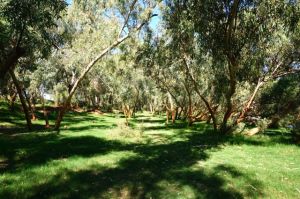
Our stunning little park up spot of de Gray River. Directly beside the river and green grass - a luxury in this part of the world

Our stunning little park up spot of de Gray River. Directly beside the river and green grass – a luxury in this part of the world

We departed Eighty Mile Beach last Wednesday and for once in our travels arrived at our intended destination – the de Grey River rest area. The area is 83km northeast of Port Headland on the Great Northern Highway or 71km southwest of Pardoo Roadhouse. Every once in a while we discover an ‘oasis’ out of nothing. When we drove into the rest area it appeared it was just another stop off amongst the tussock and red dirt. However after a wee bit of exploring we found that under the canopy of trees along the edge of the river was a lush green environment that looked more like the Waikato in the start of spring rather than Western Australia in the dry. It would have been easy to stay another night.

It was a crack of dawn start on Thursday as our plan was to drive to Port Hedland, stock up on fresh fruit and vegetables then continue along the Great Northern Highway into the Karijini National Park. Because we spent a bit longer at Port Hedland than planned and daylight was running short, we made our stop on Thursday night 230km later at the Albert Tognolini Rest area. The rest area is in Munjina Gorge and is at the top of a huge escarpment. The area is approximately twenty hectares, flat, grassy and the scenery is stunning. Being self contained (having your own power, water, shower and toilet) is a huge advantage over here as most of the best free and out of the way camping spots have none of those facilities and most require you to be self contained before you can access the site. Albert Tognolini rest area is just one example of this.

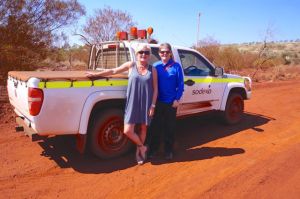
Dearne and Nicky at the road entrance to the West Angelos Mine, 70 south of Karijini National Park

Dearne and Nicky at the road entrance to the West Angelos Mine, 70 south of Karijini National Park

The Navigator was super excited on Friday morning. Her sister, Nicky, works as a Project Manager at the West Angelos Mine, about 70km from the Albert Tognolini Rest area and we had made arrangements to catch up for morning tea at the mine entrance road that morning. The girls had a great gossip and we parted company about an hour later as Nicky headed back to work and we made our way back to the entry road to the Karijini National Park.

Set in the Hamersley Range in the heart of the Pilbara, the Karijini National Park is Western Australia’s second largest national park and encompasses 627,442 hectares. This is an ancient part of the Earth. Massive mountains and escarpments rise out of flat valleys with erosion carving the shape of the Park from 2000 million year old rocks. Much of the southern part of the park is still inaccessible.

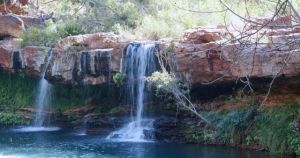
We arrived in the Park around midday on Friday, paid our National Park entry fee then booked two nights at the Dales Gorge camping ground. Like New Zealand DOC parks, toilets are normally available but that’s about it. Good self-containment is a huge advantage. After a quick bite to eat we took ourselves off on our first adventure and visited the Fortescue Falls and Fern Pool at the bottom of Dale Gorge. They were not too far from the camp but are a popular visitors spot and fitted perfectly with our late arrival.

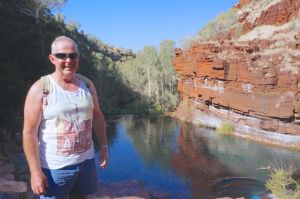
Rod at Forescue Falls in the Karijini National Park. Note his 'buzzcut' (permission was not obtained), singlet and denim shorts - all very Australia. Gaining residency should be no problem !!

Rod at Forescue Falls in the Karijini National Park. Note his ‘buzzcut’ (permission was not obtained), singlet and denim shorts – all very Australian. Gaining residency, if he wished, should be no problem !!

On Saturday morning we took ourselves off and walked the Dales Gorge Rim. The walk follows the rim of Gorge between Circular Pool and the beginning of the Fortescue Falls track. The Navigator wanted to get a few shots of Circular Pool so the walk was a good fit with our days plan. One of the things we liked about the Park was that the walks were graded according to their difficulty. Class 2 walks were generally gentle and up to Class 5 that are difficult and a high level of fitness is required. We saw no point in making it difficult for ourselves so we pottered around the Class 2 to 4. We both now feel as though we have experienced enough gorges, waterfalls and pools. Climbing cliff faces has lost some of its excitement and we are quite happy to come away from the Park with no injuries.

Just when we had successfully survived the Northern Territory crocodile danger, we found that the Karijini is host to dingo, goanna, pythons and other snakes. There was a wary eye kept on our surroundings as we walked the Park and we carefully checked shoes before putting our feet into them.

A few more shots of our Karijini National Park visit HERE .

Fern Pool at Karijini NationalPark

The stunning Fern Pool in Karijini National Park

Our Plan A this morning was to make our way from the National Park to Tom Price but we were unable to get hold of son Josh to see if he could catch up. Rather than risk a 260km unproductive drive we will have to wait until we arrive in Perth at the end of September to see him again. Plan B kicked in and we made our way back along the Great Northern Highway to Port Headland. We decided on that route because when we leave Port Headland tomorrow we want to follow the coastal road through Wickham,Dampier, Karatha an onto Exmouth.

We used the time here today to top up with diesel, water, and groceries, do some washing and clean some of the red dirt from outside and inside the van. To be fair, we have not been bothered too much by the red dirt. The captain is very particular where he takes the motorhome. Our home for tonight is the Port Hedland Golf Club. They allow travellers to stay overnight in their carpark so we are taking advantage of their hospitality.

Tomorrow morning it’s on the road again. We will follow the North West Coastal Highway to our next overnight stop – wherever that may be. There is nothing planned.

Categories: Uncategorized | Leave a comment

Discovering Australia’s West Coast

We departed Broome last Sunday morning after breakfasting with Bruce and Lyn at Cable Bay. They then drove east toward their home. As we drove out of Broome, hooked a left at the Roebuck Roadhouse and south onto the Great Northern Highway, we suddenly came to the realisation that this was the start to the end of our Australian adventure.

Our plan is to arrive in Perth at the end of September. From Perth we will spend the early summer (October, November, December) in the southern part of Western Australia before heading across the Nullabor Plain and into Adelaide for Christmas. After Christmas we will spend a few weeks in northern Victoria before catching the ferry on 1 February from Melbourne across to Tasmania for four weeks. We ship back to Melbourne on the 1 March to await our NZ shipping date (yet to be confirmed but planned for mid to late March).

A shot of Eighty Mile Beach on one of our 4WD runs

A shot of Eighty Mile Beach on one of our 4WD runs

As the time draws closer for us to come home, we are often asked ‘do we think we will be able to settle when we return?’ To best answer that question we have to go back five years to the point where we made the decision to change our lifestyle.

We came from the perspective that for too long life had become totally predictable. Week in and week out we performed similar tasks, at the same time, with monotonous regularity. The thought of taking on a new life where everyday was going to be an unknown quantity actually put a spring into our step. We had no plan except to agree that our Australia adventure was going to be our first step. We learned that to travel without a plan has led to the most profound and spontaneous experiences. A far cry from our previous ‘structured’ lives.

We are now firm and privileged members of an international exclusive club. A club without structure, a club without office bearers, a club without a single paid up member but a club of thousands of like-minded people doing their own thing and who get their greatest pleasure from helping other club members. The gypsy or nomad (sometimes grey) club.

Dearne with the Jeep on one of our beach treks

Dearne resting during one of our Beach runs

Can we go back to our original lifestyle? The answer is no. Can we settle at home? The answer is yes. We are excited about our return home to Whangamata and being with family and friends again. Health permitting, we intend continuing our exploration of New Zealand in the motorhome and will visit new worldly destinations as they take our fancy. Work is always a possibility but will be on our terms.

We think it was Christopher Columbus who said ‘you can never cross the ocean unless you have the courage to lose sight of the shore’. The analogy is that ‘risk can have its rewards’. We have definitely lost sight of the shore (and our common sense some may say).

We have spent the last three days at Eighty Mile Beach Marine Park on Australia’s west coast and approximately 350km south of Broome. We initially planned to be here for two days but we were so taken by the area we stayed the additional day. The Beach Marine Park covers an area of approximately 209,000 hectares, encompassing all of Eighty Mile Beach and stretching from Mulla Mulla Down Creek in the southwest to Cape Missiessy in the northeast. The seaward boundary extends to the limit of the Western Australia waters.

Sunset at Eighty Mile Beach. Stunning ends to a day.

Sunset at Eighty Mile Beach. Stunning ends to a day.

Eighty Mile Beach is also a significant nesting site for the flatback turtle. Between October and February each year the turtles nest on the beach and 7 to 8 weeks later their hatchlings emerge. Unfortunately we are a bit early to share the experience. The Beach also has an amazing variety of shells scattered from one end to the other. We spent several hours adding to our collection to bring home.

Eighty Mile Beach also provided us another opportunity to do more four wheel driving in the jeep. We are by no means experts so our speed probably frustrated many of the Aussie ‘professionals’ but we had a great time exploring the Beach. We came away without a mishap so were chuffed at our runs.

We leave here tomorrow and make our way further south. The plan is to stop for the night 83km northeast of Port Headland at the De Gray Rest Area.

Categories: Uncategorized | 1 Comment

Moving on from Broome on Sunday

The team off to work at the Broome Turf Club on Ladies Day. L to R; Bruce, Lyn, Dearne, Rod

The team off to work at the Broome Turf Club on Ladies Day. L to R; Bruce, Lyn, Dearne, Rod

Our Broome visit has flown past. Between work, our socialising and the number of ‘must sees’, there did not seem to be enough hours in the day. The standout for us was Broome’s huge tides. They have some of the biggest tides in the Southern Hemisphere with the difference between high and low tide being around 10 metres. The large tides provided an opportunity to experience a number of unique phenomenon.

An eerie sight at low tide about a kilometre off Town Beach was the remains of fifteen flying boats (Catalinas and Dorniers) that had been strafed and sunk by nine Japanese fighter planes on 3 March 1942. The flying boats were refuelling in the Bay and were carrying mainly women and children refugees from Java to the southern states of Australia. Approximately 80 people were killed in the attack and all were fleeing the Japanese invasion of Java and the surrounding areas. The wrecks are classified as ‘living’ graves so close access is limited.

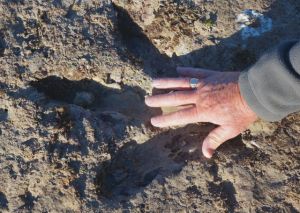
An appreciation of the size of the dinosaur print at Roebuck Bay

An appreciation of the size of the dinosaur print
at Roebuck Bay

Broome is one of the few places on earth where you can walk in the footsteps of dinosours. The footprints are recognised as the most significant in the world with tracks stretching for about 80km along the 200km of Broome sandstone coastline. It is believed that the prints were laid down some 120 million years ago with more than 20 different species having been identified. Many of these prints are scattered around Roebuck Bay and especially at Gantheaume Point where they were in easy walking distance. The very low tides provided us the opportunity to see the footprints.

Last Saturday night the boys took themselves off to the local speedway while the girls went into town for cocktails at a local resort. The Captain was not sure how long he would last as he didn’t like the thought of eating red dust all night. All was good however as the track was kept well watered. Unlike at home, the speedway had an excellent bar facility so the lads were also well watered during the evening. According to the boys they had ‘a very pleasant bogun evening’.

As most will know, Broome was built on the back of the pearl industry. What you may not know is that originally Broome’s industry was not pearls but Mother of Pearl shell. The shell was used in the production of buttons before the introduction of plastics. As part of our ‘pearl journey’, we made a visit to the Willie Creek Pearl Farm. The farm is privately owned by the Banfield family and is approximately 40km from Broome over a ‘fairly rugged’ dirt road. The little jeep and her passengers certainly felt the effects of the corrugated road. Willie Creek Pearls has the largest selection of pearl jewellery, including freshwater pearls and mother of pearl shell pieces, in the region. We spent a couple of informative hours at the farm and also enjoyed a picnic lunch on the farm’s shoreline.

A great shot from Dearne at the 'Stairway to the Moon' phenomenon.

A great shot from Dearne at the ‘Stairway to the Moon’ phenomenon.

Broome being Broome, Sunday was ‘pearl hunt’ day. After breakfast it was off to Chinatown that boasts some of the finest pearl and jewellery showrooms in the world. While the Captain stood idly by staring into space, Dearne selected and made the appropriate purchase. It doesn’t pay to think too much about the price  but concentrate more on the points one is accumulating that will enable the purchase of the GPS fishing torpedo on our return to New Zealand!!

On Monday night we visited Mangrove Resort on Roebuck Bay to watch one of natures wonders, the Staircase to the Moon. The Staircase occurs when the full moon rises over the exposed mudflats of Roebuck Bay at extremely low tide and creates the optical illusion of a staircase leading to the moon. The event occurs three nights each month between the months of March and October. It is truly a stunning sight albeit very hard to successfully photograph. The navigator did her best.

If you are ever in Broome, take time to visit Matso’s Brewery. It is the Kimberley’s award winning microbrewery and a Broome treasure. The Brewery produces a range of ciders and speciality beers on site and boasts an excellent restaurant. Matso’s also has its own ‘curry chef’ operating from a natty little alcove called the Curry Hut. We celebrated the purchase of Sunday’s pearl with a Sunday lunch at Matso’s. We highly recommended the Brewery as a ‘must visit’.

Tomorrow (Saturday) is our last day’s work at Broome’s Turf Club. It is Cup day and the Club is expecting a crowd of around 8000. We start at around 10am and will probably finish around 10pm. We have both loved the work here (albeit not a career choice), we have met and worked with some great people but it is time to move on. We will depart Broome on Sunday morning and continue our journey down the west coast of Australia. Depending on the road conditions and weather, will determine where we make our Sunday night stop. We will also bid farewell to Lyn and Bruce on Sunday morning. They are heading east and making their way slowly toward their home in Bargara (near Bundaberg). It was great catching up again guys and no doubt we will see you again soon.

More shots of our Broome visit HERE .

We are not sure about the quality of data or cell phone reception as we drive south. If you cannot get hold of us just leave a message and we will call you as soon as we are able.


Categories: Uncategorized | 1 Comment

Blog at WordPress.com.