Author Archives: Dearne and Rod

Last Day in Alice Springs

On the 11 March 1871 a telegraph line surveyor, William Mills, discovered a waterhole in Central Australia and named it Alice Springs after the wife of the Superintendent of Telegraphs for South Australia. In the 1800’s the settlement of Alice Springs played a pivotal role in the opening up of

Rod and Dearne at 5 o'clocker in Alice

The Captain and the Navigator doing what they do best

Central Australia. In 1887 the discovery of gold at Aritunga, some 100km east of Alice Springs provided the springboard for a population boom in the area. Alice’s current population is around 28,000. We love learning the history of the places we visit – some have extraordinary origins.

Our three day ‘R ‘n R’ in Alice has been very social. We based ourselves at the Big4 Holiday Park and it would have to be one of the superior parks we have stayed in. Everything is laid on for the traveller and there is a social event arranged each evening. It made for an excellent rendezvous point while we waited for our friends.
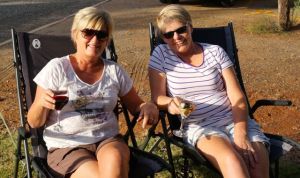
Dearne and Janet doing what they do best

Dearne and Janet enjoying a quiet ‘red’

Janet arrived safely from Hamilton on Wednesday and has moved very quickly into the motorhome mode – late wake up call, early coffee, healthy breakfast and then a bit of local exploring. The Navigator loves having a girlfriend onboard that she can gossip with and talk ‘girly’ stuff.  She doesn’t get much of that from the Captain. As a double surprise, a girlfriend that she met in January at the Elvis Festival in Parkes pulled into the Park yesterday afternoon in her motorhome. The wine was flowing last night. Di will be travelling with us on the next week of our journey.

Woolf, Rod and Woolif's partner Kevin

Woolif, Rod and Woolif’s partner Kevin having a quiet catch up

For the ex matelot’s amongst our followers, we had a surprise visit yesterday from Woolif Walsh(ex Steward). Woolif served on HMNZS Canterbury with Rod when they bought the ship out from England in the early 70’s and they also served together at HMNZS Irirangi in Waiouru during the mid 70’s. It’s amazing how people can come together after 40 years of no contact and yet the conversations flows liked they talked everyday.  It was great to catch up Woolif and safe travels for the future.

Harry and Jane arrived at the Park this afternoon and are all set for our adventure. We last saw them in November when we stayed with them for a couple of days so it was great to catch up again. We are all stored up and ready to go.

A couple more shots of our Alice Springs visit HERE .

The plan is to leave here tomorrow morning and drive into the West MacDonnell Ranges. Having three motorhomes travelling together takes a little bit of planning so we have made a tentative arrangement to overnight tomorrow night at Glen Helen Gorge.


Categories: Uncategorized | 4 Comments

Exploring the Red Centre

First off, our apologies for the tardy response to emails and cell calls – we have had no coverage since leaving Coober Pedy on Saturday and our arrival in Alice this afternoon.

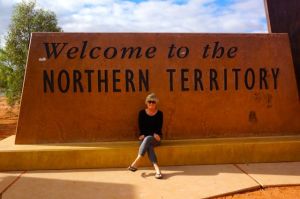
Dearne at Northern Terriority Border

Dearne at the Northern Territory/South Australia Border on the Stuart Highway

We think our departure from Coober Pedy on Saturday morning was just at the right time. At around 4am rain started to fall again and the dirt roads were turning to mud. Unfortunately for us our accommodation was 1km up a dirt road so it was a very slow drive out.

After fuelling up it was back onto the Stuart Highway and northwards. The rain continued and was mixing with the mud on the road to make for very challenging driving conditions. We made a decision that we would drive out of the rain and wherever that happened, is where we would park for the night.

Five O'Clockers on the Boarder

5 o’clockers on the Border

Around 410km later, and directly on the South Australia and Northern Territory border, we made our stop.  To be honest we could not have asked for a better overnighter. The rain had stopped, it was a no cost area, we were on flat blacktop, the rest area had lots of trees and toilets were available. By 4pm there were about eight other vans at the site and we enjoyed a very convivial end to the day.

As usual on Sunday morning we were last away from the overnight stop. We had made no firm decision on where the day was going to take us except our commitment to continue north. We visited the outback roadhouses of Kulgera, Eridunda and Stuart Wells and saw some stunning scenery as we drove beside the Finke Gorge National Park. The massive sandstone outcrops silhouetted against the blue skyline were stunners. We even had the good fortune to have a couple of close encounters with dingo and wedge tailed eagles.

Limestone Outcrops

A stunning limestone outcrop on the edge of the Finke Gorge National Park

We skirted Alice Springs itself and drove a further 30km north to our overnight stop at the Tropic of Capricorn Rest area – so named because the rest area is on the Tropic of Capricorn.  The site was just off the main road so there was a bit of overnight road noise but it was another free stop so we are not complaining. We were the ‘seniors’ at the site that night – most of the other travellers were in their early to late twenties. Somehow we were able to fit right in.

On Monday morning we were on the road by 10am and had decided to get off the Stuart Highway and spend the night at Gemtree, a roadhouse 140km NE of Alice Springs along the Plenty Highway and in the East MacDonnell Ranges.  We were expecting the road to be dirt but were surprised to find it was blacktop all the way to Gemtree front gate. It was only a single lane road so pulling into the red dirt was a frequent passing manoeuvre.

Relaxing at Gemtree Bush Camp

Rod relaxing at the Gemtree Bush Camp

The area is known as the Gateway to the Red Centre Gem Fields and is famous for such gems as zircon and garnet to name just two. We made our home for the night at the Gemfields Bush Park, 100 hectares of outback bush land but with all the facilities. For $22 we had a nice flat grassy site amongst the trees and about 50metres from our nearest neighbour. As we did not need power or water, we were able to pick wherever it suited us. Our hosts, Aaron and Kate McMaster, made us feel very welcome and Aaron being a kiwi from Masterton, was an added bonus.  We had a very pleasant and peaceful stay. If you were passing through, we would recommend a night or two there.

This morning we returned along the Plenty Highway to the Stuart Highway, turned left and explored the 140km back to Alice Springs. We arrived in Alice late this afternoon and are now camped for the night at Ilparpa, about 12km south of Alice city centre.

From tomorrow we have three nights in Alice Springs while we await our intrepid travel companions. Young Janet Brothers from Hamilton is flying into Alice on 8th May and is going to visit the MacDonnell Ranges with us. On the 10th May, Harry and Jane Parker from Nelson Bays on Australia’s east coast are also flying in, hiring a motorhome and journeying with us to the Western MacDonnell Ranges and Uluru (Ayres Rock).

Our next week on the road should be very social.


Categories: Uncategorized | 2 Comments

Our Coober Pedy Adventure

The Navigator in the driving seat for the day

The Navigator in the driving seat for the Port Augusta to Coober Pedy leg

Our departure from Port Augusta on Tuesday was slightly delayed as when we were hitching up the jeep we noticed a screw had gone in to the left front tyre. While the tyre didn’t appear to be losing air, the thought of having to do a repair in the middle of nowhere did not appeal. The local Tyrepower outlet in Port Augusta was most obliging and shifted us to the front of the queue. Within 30 minutes the tyre was fixed and we were on our way.

We decided to swap roles from Port Augusta to Coober Pedy – the navigator became the Captain and vice versa. The first few hours of our drive north on Tuesday was in the pouring rain. We tried hard not to complain as the area desperately needs rain but it made for very unpleasant driving conditions. The wet made pulling to the side of the road a risky manoeuvre as the edges can be very soft in the wet then getting back onto the blacktop presents challenge.

Our first stop for the day was the Pimba Roadhouse about 180km north of Port Augusta. We did give some thought about either overnighting there or at Woomera but the ground was water logged in both areas so we carried on a further 200km north to the Bon Bon Rest Area. By this time the weather had cleared and the rest area had some good dry surface spots.  That was it for the day – we felt that 380km was enough.

A very typical Coober Pedy landscape

A very typical Coober Pedy landscape

Seven other vans pulled into the rest stop over the next few hours and one of the couples, Adela and Terry, hailed from Miranda on the Firth of Thames. They were travelling in the same direction as us but at a faster pace as they are heading back home in June of this year. We shared a few wines that evening and made a commitment to catch up again when we got back to New Zealand.

On Wednesday morning we the drove the final 180km in stunning weather into Coober Pedy. Dearne did a splendid two days at the wheel. After a quick around the town familiarisation, we made our way to our accommodation at Riba’s Underground Camping and Tourist Park. We had planned to stay three days there – two nights in the motorhome and one night in the Parks underground motel – another first for us. It was a bit primitive but it is what it is.

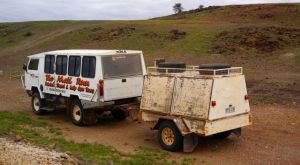
Our Mailrun Transport

Our Outback Mailrun Transport

‘Crack of dawn’ on Thursday morning we made our way into town to meet the driver of our days entertainment – The Outback Mail Run.  What a brilliant day.  The run allows you to live the life of the outback mailman as he delivers and collects mail and supplies to the remote cattle and sheep stations in the area.

Over the 650km travelled we met some wonderful and resilient outback families. They don’t measure their farms by hectares here – it is all stated in square kilometres. Five thousand square kilometres ‘plus’, is the norm. We travelled part of the Oodnadatta Track, lunched at the outback settlement of Oodnadatta, saw parts of Australia’s 5614km’s of dingo fence, saw the remains of the now defunct Darwin to Adelaide Ghan railway and of course a broad range of wildlife (including wild dingo).

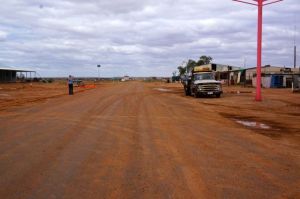
Mainstreet Oodnadatta

Mainstreet Oodnadatta

While it was a long day, 12 hours, under normal circumstances we would never have been able to access many of the areas we visited. The motorhome or the little jeep are just not designed to travel the types of roads we were on.

We were slow to arise this morning and spent a couple of hours catching up on domestics before heading into town to have a good look around. We visited another underground facility then went in search of a ‘little opal trinket’ for Dearne. She could find nothing that took her eye so we came away with a relatively stable bank account. I need not remind you that we still have the sapphires we mined at Sapphire in Queensland that we have yet to have polished and mounted. ‘Apparently’ we have to go to Thailand to have that done because they do a  ‘really good job’ up there!!

We depart Coober Pedy tomorrow (Saturday) and continue our journey north to Alice Springs. The plan is to arrive there on the 7th May. We are not sure where we will overnight on the way or if we will have cell reception between Coober Pedy and Alice. If you cannot get hold of us, or do not here from us, you will know the reason why.

More shots of our Coober Pedy visit HERE .

Categories: Uncategorized | 1 Comment

Departing Port Augusta

We are in our final day at Port Augusta and have thoroughly enjoyed ourselves. The region has an incredible history and there is certainly plenty to see and do.  Port Augusta is at the very top of Spencer Gulf and if like us you are travelling tomorrow northward through the centre of Australia, it is the last major town before Coober Pedy.

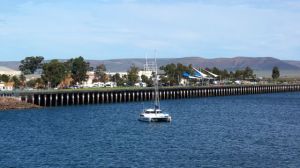
Pt Augusta

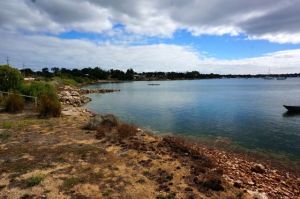
Port Augusta Harbour and looking towards the city

The Spencer Gulf was first explored in 1802 but it wasn’t until 1852 that Port Augusta was named after Augusta Marryat, the wife of the first civilian Governor of South Australia. A key issue for Port Augusta both then and now, has been their water supply.

There was no reliable drinking water in the area until 1865 when a pipeline was laid from Woolundunga Spring in the Flinders Ranges to Port Augusta. Nowadays, a pipeline from the Murray River supplements the area’s water supply and the town recycles its wastewater from a modern local plant. Even now visitors to the city are asked to either purchase their drinking water from retail outlets or if travellers like ourselves, obtain our water from the local caravan park.

While much of our time in Port Augusta has been preparing (vehicles and ourselves) for the next leg of our journey, we were still able to get out and about. We undertook a couple of great walks around the Gulf foreshore, spent an afternoon at the Wadlata Outback Centre and even managed to go out to dinner on Saturday night.

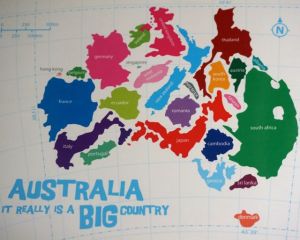
Australia Map

Our journey is put into perspective when you realise how big Australia is compared to other countries.

The only task we have yet to do is to fill the motorhome with diesel tomorrow morning before we leave. We were pleased to see today that diesel is down to $1.53 per litre. With our 4 cents a litre discount we get for grocery shopping at Woolworths, we should be buying diesel tomorrow at $1.49 per litre – a big change from $1.80 per litre over Easter.

We are not sure if we will have telephone coverage between Port Augusta and Coober Pedy. If family cannot get hold of us, don’t panic. We plan to be in Coober Pedy on the 30 April.

Categories: Uncategorized | Leave a comment

Smoky Bay to Port Augusta

We are onto another one of those Plan B’s. When we commenced our drive along the Eyre Highway on Tuesday, we had every intention of arriving at Port Augusta around the 27 April. However we received a call from a friend in Alice Springs to advise us that the Ulysses Motorcycle Club are having their annual AGM and Rally in Alice at the same time we will be in the area. Accommodation and parkup opportunities will be at the premium. Consequently we are now in Port Augusta where we find it much easier to get ourselves organised rather than trying to do it on the road where reception is not always good.

Our journey from Smoky Bay to Port Augusta was a relaxed. While we could have done a long drive and made it in a day, there were a couple of things we wanted to see on the way.

The first stop on Tuesday was at the township of Ceduna to replenish the groceries. Ceduna is known as the business hub of the area and has a history in agriculture, salt and gypsum mining and of course seafood. The town has strong Aboriginal cultural ties that can be seen in its population. We had a wander around the town, partook in a ‘long’ lunch, then headed eastward along the Eyre Highway.

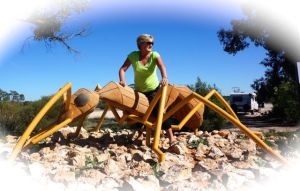
Dearne on the Dinosaur Ant

Another Australian ‘big thing’ – Dearne on the dinosaur ant at Poochera on the Eyre Highway

We spent Tuesday night in the tiny grain village of Wirrulla. Wirrulla is the service centre for the surrounding farming community and for some reason it has an inland jetty almost in the centre of town. The town is nowhere near the ocean or a river and no one could explain to us why the jetty was there. We parked up for what we thought was going to be a nice quiet night on the old school tennis courts (the school was closed some 15 years ago).

What we didn’t know was that Wirrulla was the converging point for road trains coming from three different directions – from Ceduna and the Nullaboor, from Port Augusta and Adelaide and from Coober Pedy and Alice Springs.  They all arrived together at about 2am on Wednesday morning, unloaded their forkhoists from the rear of the trucks and commencing shifting their loads between one truck and another? This went on for about 2hours. You can only imagine the noise. Then, as if by signal, the forkhoists were reloaded and the trucks departed. Wonderful silence! We were well and truly awake by that time and had no chance of getting back to sleep.

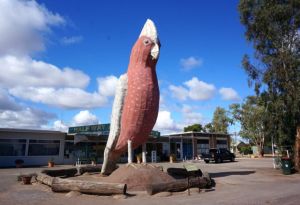
The Galah

One more Australian ‘big thing’ – an 8 metre Galah at Kimba

Wednesday morning (early!!) it was back on the Eyre Highway and making our way east toward our next overnight stop of Kimba. Kimba a geographically half way across Australia and is well known as the eastern gateway to the Gawler Ranges. The district is one of South Australia’s major grain belts. Kimba is also famous for another one of Australia’s ‘big things’ – an eight metre tall ‘big Galah’.

The town is another of Australia’s RV friendly towns and provides free camping near the centre of town at their Lions Project Park. It was a stunning little site and not a noise was heard all night.

We had a slow start this morning but were in no hurry. It was only 150km to Port Augusta and we really had nothing to do today once we arrived there. We drove into town at about 1pm this afternoon and took the opportunity to take the motorhome and the jeep to a carwash to give them a good clean. Both were looking a little sad after our three or so weeks on the Eyre Peninsula. It was a very dusty place.

Tomorrow is ANZAC Day and we plan show our respect and appreciation by attending the local RSL’s commemoration ceremony. We have been told there are no retail shops open tomorrow so we will leave our stock up until Saturday.

Our plan is to leave Port Augusta for Coober Pedy on Tuesday 29 April.


Categories: Uncategorized | 2 Comments

Departing Smoky Bay

Smoky Bay

Smoky Bay beach

It’s funny how a stop over turns out. When we first parked up at Smoky Bay, there was a reluctance to stay the whole weekend as it appeared we were being ‘packed’ in and we have not been used to travelling like that.  However we decided that unless we wanted to drive on, that was going to be our Easter weekend.

On reflection, the weekend in Smoky Bay has been brilliant – sunny blue skies with daytime temperatures around 26C, a full social calendar and the captain has at last got his head around the different way of fishing over here.  Small hooks, small bait and never be surprised at what comes to the surface – he was at last catching fish we could eat. We ended up by staying an extra day.

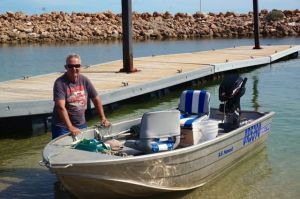
Rod on his fishing expedition

Rod heading out for a morning on the water

While most of his fishing was done off the long pier from the beach, he was also lucky to score a couple of mornings on the harbour with our ‘next door neighbour’ and his tinny.  Some of the fish we have been feasting on this weekend include Australian sea salmon, tommy rough, snook (they look a little bit like barracuda but are smaller), King George whiting and trevally. He is a happy man at the moment I can assure you.

We leave Smoky Bay tomorrow morning (Tuesday) and make our way toward the township of Ceduna located on the far west coast of South Australia and on the shores of Murat Bay on the Great Australian Bight. The pantry and refrigerator are in need of a top up and we are hoping that the price of diesel will drop after the Easter Weekend break. Prior to Easter, the price rocketed up by 20 cents a litre and has been held there all over the weekend.  We normally pay around $1.60 per litre but it was nearly $1.80 last Thursday.

From Ceduna we will turn right onto the Eyre Highway and slowly make our way back to Port Augusta. The plan is to arrive by about the 27 April which will give us a few days to prepare the van (and ourselves) for the ride up the middle. We hope to depart Port Augusta during the first few days of May.

Categories: Uncategorized | 2 Comments

Into Smoky Bay for Easter Weekend

Murphys Haystacks

Murphy’s Haystacks at sunset

Our journey on Monday took us through Elliston, past Port Kenny and to one of the Peninsula’s tourist attractions – Murphy’s Haystacks. The haystacks are formed from ancient granite rocks dating back some 1,500 million years. The pillars and boulders in their present day form only go back as far as 100,000 years!!

Local legend has it that the formation acquired its name when a Scottish agricultural expert first saw the landmark from a distance and likened them to a ‘haystack’. A Denis Murphy then owned the land surrounding the ‘haystacks’, so ‘Murphy’s Haystacks’ they became. An additional attraction for us was that the site offered an overnight stop opportunity. For $4.00, we had a park for the night.

On Tuesday morning we were back on the Flinders Highway and heading north.  As we said in the last blog update we were hoping to find an Easter Weekend stopover somewhere between Elliston and Streaky Bay but in reality there is not too much around. Ninety percent of the roads from the Flinders Highway to the west coast of the Peninsula are dirt roads and many are not suitable for the motorhome to travel on.

Haslam Waterfront

Haslam waterfront from the pier

We spent an hour or so having lunch and a wander around Streaky Bay then continued a further 30km north to the coastal village of Haslam. Haslam has the reputation of providing low cost camping to motorhomers and caravaners who have just completed, or are embarking on the Nullabor or who are heading across to Port Augusta to start on a journey up the middle. We gladly took full advantage of the village’s hospitality. For $5.00 per night, we were about 50 metres from the water and on good hard ground. We ended up staying for two nights.

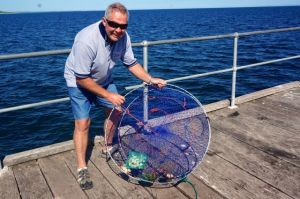
We awoke Wednesday morning to a brilliant day and after a ‘late start’ it was out fishing gear and crab pot and onto the Haslam jetty to try our luck. We are still struggling with the size of fish people are keeping over here – 8cm to 10cm is a keeper with some species!! To the Captains credit, all his catch was returned to the ocean. The crab pot produced half a dozen good-sized sand crabs but again, it was the big blue crab he was after so the catch went back into the sea.

Rod crab hunting

Rod emptying his crab pot – only sand crabs unfortunately

While at Haslam we managed to secure ourselves a four-night parkover during Easter weekend at Smoky Bay, another seaside village a further 40km up the coast. So this morning it was back on the road and into Smoky Bay.

Smoky Bay has a population of 200 and is the regions producer of Pacific Oysters. The Smoky Bay oyster farmers supply 50% of the local, interstate and international markets. The plan is to stay here until Easter Monday then head east again towards Port Augusta where we will pause for a few days before heading up the middle.

Have a great Easter break everyone and if you are travelling, drive safe.


Categories: Uncategorized | Leave a comment

On the West Coast of the Eyre Peninsula

The weather has continued to be a bit of a blight on our journey since leaving Adelaide two weeks ago. Overcast and windy conditions have prevailed. For the first time in three or four months we have had to run the generator to top up the batteries. We are not complaining but it is just another thought pattern that has to be adopted to ensure our travel meets with the minimum of hiccups. We could go into a motor camp to plug in but that is not how we are travelling.

Rod’s Port Lincoln fishing charter on Friday was a non-event. While he left it until Friday morning to commit (because of the weather), the operator was a no show anyway. Rod was not too worried about it – we spent the afternoon on a walk around the waterfront taking in all the attractions.

Coffin Bay

Coffin Bay from our lunch stop

We departed Port Lincoln on Saturday afternoon and made our way 50km southwestward to Coffin Bay. The attraction of Coffin Bay was the Coffin Bay Oyster grown in the many lease areas within the bay system.  While the oyster is not as ‘fat’ as New Zealand’s Bluff oysters, the local price of $9 per dozen makes it an affordable delicacy. We are well stocked and look forward to enjoying them at 5 o’clockers over the next few days.

While we were staying at Billy Light’s Point in Port Lincoln, a fellow traveller told us about a ‘must do’ while at Coffin Bay. About 12km out of Coffin Bay (on a dirt road!!), there is a tourist attraction at Wangary called Minniribbie farm. The farm is dedicated to producing 100% free-range pork from the famous heritage breed Berkshire pig.  While the Berkshire pig is black, the meat is pale pink and delicious.

At the pig farm

They were very close to being our travelling partners

The farm had its’ own cafe and quirky little antique shop (with carpet delicately covering the dirt floor) and visitors had access to the entire farm. This was Dearne’s first visit to a free-range pig farm and the standout for her was that the pigs were not caged. They were able to roam free in large fenced grassy paddocks, wallow in mudpools and each paddock had its own fresh straw shelter. If she could have smuggled a piglet into the van I am sure we would have had a pet for the rest of the journey.

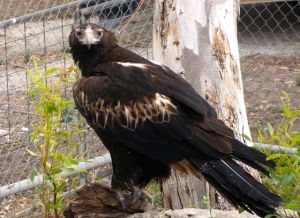
While we were at the farm we got our first close up of an Australian wedge-tailed eagle. A car had hit the eagle some months ago and as a result of it now being unable to fly, it is a permanent fixture at the farm. Gee they are big – with a wingspan of some 2.3 metres and weighing in at about 5kg, the bird is Australia’s largest bird of prey. While staff said it was relatively friendly, we kept well clear of its’ claws and beak.

Australian Wedgetail Eagle

The Australian Wedgetail eagle at the pig farm

By the time we left Minniribbie farm it was getting late in the day so we continued northwest on ‘our dirt road’ to a little place called Farm Beach Cove.  We discovered a low cost camping area directly beside the coast and, at the time of our arrival, out of a cold southerly wind that had sprung up during the day. While we were thankful for the overnight stop, the wind and the dust had us moving on early the next morning.

On Sunday we retraced our steps along the dirt road back to the Flinders Highway then continued northwest with the goal of reaching Elliston by the end of the day.  However, as per our normal travelling style, we didn’t quite make it. Whilst driving, we heard about an ‘off the beaten track’ camp area that was worth a look.  The camp was at Sheringa Beach at the end of 8km of dirt road and on the coast some 39km south of Elliston.

Sheringa Beach Camp Spot

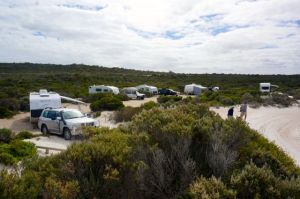
Our beach bush camp at Sheringa Beach

The camp was very small and had room for about eight vehicles. I think we were vehicle number eight. We found our parking space, unpacked and spent a pleasant (but cold) 24 hours at Sheringa Beach. We know its getting cold because when we were watching the news on TV last night, a little mouse ran across the arm of the lounge suite. It must have snuck into the warm of the van. It could have been worse – it might of been a snake. The mouse traps will be set tonight.

This morning (Monday) we were back on the road and heading further north. We are conscious of the fact that it is Easter Weekend in Australia this weekend so we want to be off the road and sorted in terms of a stopover by at least Wednesday. The plan is to have a look between Elliston and Streaky Bay on the Eyre Peninsula’s west coast to see what we can come up with.

Categories: Uncategorized | Leave a comment

Tumby Bay to Port Lincoln

We loved our three days at Tumby. Like most of Australia’s coastal villages, Tumby has an interesting history. Mathew Flinders (of Flinders Ranges fame) first explored the area in 1802 and named the bay after the village of Tumby in Lincolnshire, England. In the early years Tumby was an important grain and loading port for the cereal and sheep farming industries. Today, it is primarily a service centre for the farming industry and a popular holiday and fishing spot.

Dearne before our buggy ride at Tumby

Dearne with her friend just before our buggy ride around the township of Tumby

A note of interest for the ex service people following the blog – in 1949 the Australian government purchased approximately 16,000 acres of land surrounding Tumby Bay and developed 69 blocks with housing that was allocated to servicemen returning from the war. The village has a strong RSL influence with many of the servicemen’s descendants still residing in the area.

Unfortunately, the weather showed very little improvement during our stay at Tumby Bay. While it never poured down, the near constant drizzle made getting out and doing ‘stuff’ just a little more difficult. In saying that, we thoroughly enjoyed ourselves and were able to have a good look around. We would have no hesitation in revisiting Tumby.

On Wednesday morning we made our way a further 50km south to the town of Port Lincoln. Port Lincoln is Australia’s largest fishing port producing a diverse range of seafood worth hundreds of millions of dollars to the state and local economies.

Our first stop at Port Lincoln was the dentist for Rod. Unfortunately for him a porcelain veneer came lose and he swallowed it!! I did suggest there was a way ‘he’ could find it and surprisingly the idea didn’t really put him off.  Once found however, he struggled with the notion of popping the veneer back into his mouth. Suffice to say he has taken the easy way out (but not the cheapest).

Port Lincoln Township from Billy Light's Point

Port Lincoln township from our parkup at Billy Light’s Point

We are staying at Port Lincoln until Saturday and are parked up about 9km from the city centre at Billy Light’s Point. For the princely sum of $10 per night we are on a nice quiet tar sealed area about 15 metres from the waters edge. There were three vans here last night but as I write, we are on our own. Other travellers normally role up towards the end of the day.

Weather permitting Rod is considering going on a fishing charter tomorrow – we will let you know. The navigator will take opportunity of his absence to undertake a few hours of retail therapy in town.


Categories: Uncategorized | Leave a comment

Onto the Eyre Peninsula

Our departure from Adelaide last Friday morning was uneventful and to plan. The GPS got us out of the city and onto the Augusta Highway towards Port Augusta, the next stage of our Australian journey. As we had previously explored the coastline and inland areas between Adelaide and Port Pirie, it was a 306km non-stop drive north to Port Augusta. Once in Port Augusta, a decision had to be made,  ‘where to from here’.

After a bite to eat, we decided to drive 76km down the northeastern coast of the Peninsula to Whyalla. Whyalla is the home of OneSteel (formerly BHP Steel) and a city renowned as a steel and shipbuilding hub. The steelworks itself is most impressive and can be seen from miles away. It was getting late in the day and the only place we could find to overnight was the local sports ground. No complaints tho’ – our fault, but $10 gave us a parking space, a shower and toilets.

Road to Pt Gibbon

The long dirt road into the Port Gibbon camping area

On Saturday morning we continued further south and stopped briefly at Cowell. We had intended to make the town our overnight stop but the feedback we received from other travellers was that it was an ‘unfriendly’ travellers stop so we passed on through.

While we were in Cowell, we heard positive comments about a little seaside village by the name of Port Gibbon. The village was a further 40km further south on the Lincoln Highway then on an 8km of dirt road to the coast. We are normally averse to playing on dirt roads but in this instance we decided to give it a go. What a stunning little place! There were about six holiday homes there and the rest of the ‘population’ were travellers such as ourselves. 5 o’clockers was a very social event.

Rod @ Pt Gibbon

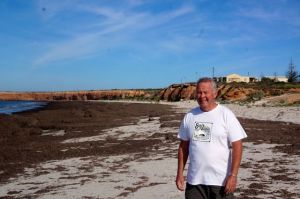
Strolling along the 10km of Port Gibbon beach.

The navigator became very nervous when other travellers informed her that the area was rife with scorpions. They apparently came out at night and settled in shoes, on jandels (thongs for our Australian followers) and matting. Consequently, there was not too much activity after dark outside our motorhome that night!!

It was our intention to stay at Port Gibbon for two nights but when we ‘finally’ surfaced on Sunday morning, most of our fellow travellers were starting to pack up. We were a little surprised as the previous night most said they were staying until Monday.  We were informed that overnight, the weather forecast had changed and was predicting rain within the next 24 hours. Apparently the area we were in was prone to flooding. We figured that between the flooding and the mud that would follow the rain, we would pack up as well. We were on the road by midday in beautiful weather. At that point we were having our doubts about the forecast. However by 3pm the skies were turning very dark and threatening.

Modra Apartments Parking

Our ‘dry’ parkup at Tumby Bay

We are currently settled at the small seaside village of Tumby Bay (about 50km north of Port Lincoln) on an RV site beside the Modra Apartments. We are on a hard surface, have power and water so the weather can do what it wants over the next few days. Our plan is to stay here until Wednesday by which time we hope the inclement weather passes.

At midnight last night (Sunday) the rain started and is still falling this morning. Our decision to shift on from Port Gibbons was the correct one – always go on your instinct. The campsite and access roads would be a ‘little’ muddy by now we think.


Categories: Uncategorized | 1 Comment

Create a free website or blog at WordPress.com.