Author Archives: Dearne and Rod

Relaxing in Broome

Our journey from Derby to Broome last Wednesday was a quiet one. The distance is only 250km but we cannot get over how little traffic there is on some of the main routes. On our drive we think we only saw about six other vehicles over the distance.

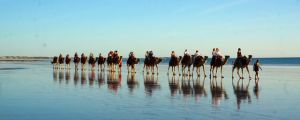
A camel train on Cable Bay beach

A camel train on Cable Bay beach

Even after a few days in Broome it is feeling a bit like home. Known as the gateway town to the West Kimberley, it is surrounded by water with the world famous Cable Beach to the west and the pristine waters of Roebuck Bay to the east and south. The population seems to spend most of their time around or on the water as we do at home.

Broome has a very broad multicultural population. There is a blend of Malay, Chinese, Japanese, Filipino, Aboriginal and European who all came together in the early 1870’s to work the pearl luggers in search of the pearl. The descendants of many of those early settlers still reside in the town today. The multicultural aspect of the population was very evident in our ‘workplace’ at the race meeting on Saturday.

Dearne is very excited to be in Broome as the area produces the world’s finest pearls and she has a vision of purchasing a fine example of the local product. As you know we have managed to pick up a bit of work while we are here. I did notice in conversation the other day that ‘my’ earnings now seem to be in the ‘our’ earnings category and are going toward ‘my’ pearl. I wonder if the same rule will apply if I want to add to my fishing gear collection when we get home? Yeah right!!

The nomads at lunch in Broome. From L to R: Jane, Dearne, Bruce, Steve, Rod and Lyn

The nomads at lunch in Broome. From L to R: Jane, Dearne, Bruce, Steve, Rod and Lyn

On Thursday night we caught up with Bruce and Lyn who are travelling in the opposite direction to ourselves and Steve and Jan who are travelling in the same direction but who have been a few days ahead of us. We met at Cable Bay Beach, partook in a few beachside wines and followed it up by enjoying a dinner at one of the local waterfront restaurants. It was great to catch up with everyone again. Jane and Steve have now headed off and are continuing their journey toward Perth.

There is quite a lot to do and see in Broome. Because of our work and our ‘must sees’, we will be in Broome until around the 18 August. Rod would like to spend a few hours on one of the pearl boats and we would also like to visit one of the towns many pearl farms. We have already been to the Courthouse weekend market, spent a few hours socialising and dining at the local fishing club, completed our first days work and have visited some of the local sights. To top it off, the daytime temperatures are around 30C and the night time temperatures drop to around 17C.

It is very comfortable living here and not a bad place to spend a couple of weeks. We will keep you updated.


Categories: Uncategorized | Leave a comment

Enjoyed Derby and the Horizontal Falls

We departed Larrawa Station late Saturday morning and made our way to Fitzroy Crossing. The town is one of two along the 1000 km stretch of highway between Broome and Kununurra. About 80% of the Fitzroy Valley population are indigenous Australians with a split of closer to 60/40 (Aboriginal/settler) in Fitzroy Crossing itself. Tourism, cattle stations and mining are the main industries in the area.

The town owes its existence to the Fitzroy River. Every wet season the river swells into a formidable torrent. It can rise up to 13 metres and flow at 30.000 cubic metres per second. The Fitzroy in full flood is one of the largest rivers in the world. We are in the region during the dry season so did not have to consider battling the regions wet season challenges. As it was late in the day, we decided to make Fitzroy Crossing our stop for the night. There were no free parking opportunities in the area so we booked in to the local caravan park and took an unpowered site. We were on lovely green grass area all to ourselves. A ‘quiet’ way to end the day.

Dearne beside the Boab Prison tree in Derby

Dearne beside the Boab Prison tree in Derby

On Sunday morning we decided to drive toward Derby but make a stop for the night ‘somewhere’ along the way. As it turned that ‘somewhere’ never happened. There were no stops that caught our eye and by 3pm we were in Derby. At this time of year both Derby and Broome are ‘chokka’ with tourists and travellers such as ourselves so we held little hope of getting any accommodation that night. As luck would have it, the site we had booked for Monday and Tuesday night in Derby had a vacancy for the Sunday nite – problem solved!!

Derby is located two hours north of Broome in Western Australia’s northwest. Derby was the first town to be settled in the Kimberley and is the main access point to the Gibb River Road, Windjana Gorge National Park, Tunnel Creek and the small islands of the Buccaneer Archipelago. Located on King Sound, Derby has the highest tides in Australia, with the peak differential between low and high tide reaching 12 metres.

As with many states in Australia, employment is primarily in the farming, mining and tourism industries. There is oil at Blina, diamonds in the Phillips Range, stone is quarried from the King Leopold Ranges and lead and zinc from Cadjebut. We are in no doubt why they call it ‘the lucky’ country.

Derby is also the home of the Boab tree and more especially the Boab Prison tree. This huge tree is believed to be around 1,500 years old and has a girth of 14.7 metres. It is completely hollow in the middle and was used as staging point for aboriginal prisoners being walked into Derby in the early days. We took a drive to the tree on Monday and at a best guess we thought 20 or more people could be ‘housed’ within the trees central trunk. Amazing! – unless of course you are one of those ‘housed’ in the middle.
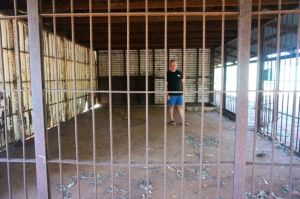
Rod temporarily in the old Derby gaol

Rod temporarily in the old Derby gaol

We made a visit to the old Derby gaol. It is the oldest building still standing in Derby and dates back to 1906. The old Derby gaol is symbolic of what the authorities felt was appropriate for keeping law and order in this remote part of Australia. The gaol is minimal to say the least! It differs to others in that it is not a substantial stone or brick structure but is constructed of galvanised iron and bars only. Chain rings can still be seen on the concrete floor where prisoners were chained by the neck. Early Western Australia was a rough and tough country and much of its history appears to be attributed to the resistance of the Aboriginal people to the new settlers – and after considering some of the history, who can blame them??

We had a lovely lunch on the Derby Jetty on Monday. Located two kilometres east of Derby townsite, the jetty experiences the highest tidal range of any wharf in Australia, the tide can reach up to an amazing 12 metres. The present jetty was constructed in 1963/64 and replaced the 1885 wooden structure.

This morning we were picked up at 8.15am to start our adventure to the Horizontal Falls in the Buccaneer Archipelago. The Archipelago is a beautiful area consisting of approximately 1000 rocky islands with small bays and secluded white sandy beaches. The area is made up of massive sandstones and was created some 1800 – 2500 million years ago. The area has huge 12 metre tidal ranges. This creates the phenomena of the Horizontal Waterfalls in Talbot Bay. The falls are caused by the differential created when the tide flows between narrow island gaps. The narrowest island gap is 7 metres and the widest is 20 metres.
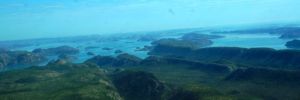
The Buccaneer Archipelago from 2000 feet

The Buccaneer Archipelago from 2000 feet

It was a 10-minute ride from our camp to the Derby Airport followed by a 30-minute flight in a Cessna floatplane to Talbot Bay, the Horizontal Falls base. The base is a group of three houseboats rafted together with pontoons for the floatplanes and speedboats. We were welcomed by an enthusiastic group of employees who outlined our day. Oh to be forty years younger – we both would have loved their jobs!!

After a morning tea it was onto the speedboats and away to the Falls. We both have to admit to a wee bit of trepidation when we saw the 1 metre water drop – especially at the narrowest gap. However we barrelled on through and with no dramas. After a few runs through the falls we were then taken to Hurricane Creek, so called because of its position in Talbot Bay and the shelter it provides vessels during the hurricane season. At the conclusion of the Creek visit it was back to the base for lunch.
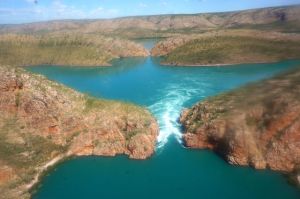
One section of the Horizontal Falls - its nature but it's scary

One section of the Horizontal Falls – its nature but it’s scary

Those of you who know Dearne will be aware that she is scared of heights. After our Bungle Bungle helicopter flight however, she has developed a love of helicopters.The Falls base had a small Robinson helicopter on the roof of one of the houseboats. Thirty minutes later and with the wallet a $100 lighter, she was gone. The helicopter ride was far more important than the lunch!!

After lunch it was another quick ride through the widest fall (with the tide rising the narrow fall had a drop of about 3 metres and considered to dangerous to traverse) and it was back to the base to catch our floatplane back to Derby. We have had a stunning day. If you get the chance to come up here, make a point of visiting the Horizontal Falls. You will not be disappointed.

More shots of our Horizontal Falls visit HERE .

Tomorrow (30th) we make our way to Broome. Believe it or not we have a few days of paid work in Broome. One has to keep one’s hand in. Our plan is to be in Broome for about three weeks. We will keep you updated.

Categories: Uncategorized | 1 Comment

Still travelling west toward Derby

Our campsite at Mary Pool - a stunning spot

Our campsite at Mary Pool – a stunning spot

As so often has happened in our journey around Australia, we come across many unexpected memorable stopovers. Our journey from the Bungle Bungle has been no different.

We departed the Bungle Bungle on Tuesday morning and travelled 200km to Halls Creek to top up with diesel and have a bit of a look around. To be fair there was not much to stop for and our friend Nick was out of town on business so we decided to carry on through. The plan was then to drive through to Fitzroy Crossing for the night. However about 50km west of Halls Creek we came to a sign that advertised free camping beside Mary Pool in the Mueller Ranges. Always looking for an adventure, we hooked a left and drove about 500m down a dirt road, crossed a concrete floodway and entered a flat area of approximately 6 hectares. There were about 20 other vans already on site so that was us for the night.

We parked up about 50 metres away from the water as we have been finding the mosquitos are very active at sunset around water. The ploy worked and we had no problems at all. It was a great little spot that has quite an indigenous history. We met some wonderful fellow travellers, spent a few hours fossil hunting on the riverbed (while keeping a careful eye on the sunbathing crocs) and each evening enjoyed a very social 5 o’clockers. We ended up staying at Mary Pool for two nights.

The unfortunate calf that appears to have been taken by a croc

The unfortunate calf that appears to have been taken by a croc

One of the first people we met at Mary Pool was an ol’ sailor travelling on his own and towing a 7 metre trailer yacht behind a vintage Ford Falcon. He spends six months each year travelling this way and sailing as many waterways around Australia as he can find. He uses the yacht as a ‘caravan’ when it is not on the water. His wife passed away two years ago and he decided to carry on their journey. He is in his 79th year and talking with him was truly inspirational. His story was just another incentive not to waste one’s life.

Our fossil hunting was extremely rewarding. We found rocks that were thousands of years old that had lizard and insect parts visible within their form. The good finds are now in the van and we are hoping we can get them back into the country when we return to New Zealand. What will we do with them? Who knows – they are bound to be a good conversation piece. The Navigator found a skull that was most likely that of a young cattle calf. The skull had deep ‘tooth’ indentations around the muzzle and eyes and it would appear that a crocodile had taken the calf as it drank from the river. All the more reason to adhere to the five-metre rule.

On Thursday morning we departed Mary Pool around 10am and made our way 40km west to Larrawa Station Bush camp. The Camp is 4km off the main highway and is a lovely natural setting amongst small trees and spinifex on a working cattle station. We discovered the station is around half a million acres and cattle from there are mainly sent to Queensland for fattening in the feedlots for the Australian market.

For the sum of $20 per night we had clean new showers, flushing toilets, sparkling fresh cold water and fire pits. There was a number of walks on the station with the shortest being a 3km return walk to Christmas Creek. It is the dry season here so much of the creek was just a stone bed with a few pools but it gave us the chance to do a bit more fossicking.

The Captain trying to keep the livestock away from the awning tie downs at Larrawa Station

The Captain trying to keep the livestock away from the awning tie downs at Larrawa Station

The Station is also the home to a variety of wildlife. The Northern wallaby and the bilby (both endangered species)  are just two who appear magically at sunset. Speaking of sunset, the station has developed seating at the top of a small mound close to the camp where guests can wander up to at the end of the day with their camera’s, wine or whatever and socialise as the sun goes down. A great way to end the day and to meet our fellow travellers.

We enjoyed the station so much we ended up by staying last night and tonight. Many thanks Wendy for providing such a great stopover and of course for the fresh farm eggs.

Tomorrow morning (Saturday 26th) it’s back on the road and to Fitzroy Crossing. We need to pick up a few groceries, fresh fruit, veges and top up with diesel but have yet to plan our accommodation after tonight. As we said the other day we know we have to be in Derby by the 28th pm so there is no time pressure at this point – as long as we limit our exploring, we should eat it in two days.


Categories: Uncategorized | 1 Comment

Purnululu National Park and the Bungle Bungle Range

Our departure on Sunday from Kununurra threw up a great surprise and only demonstrating that the world is a very small place. We popped into town prior to our departure to pick up fresh milk and a few groceries and we ran into an old navy friend, Nick Pritchard. Nick and his wife Julie are doing a similar journey to ourselves but are working their way around Australia. Nick and Julie live and work in Halls Creek but were up in Kununurra on business. It was great catching up and we made a commitment to visit them as we passed through Halls Creek as we head west.

Dearne and Rod before the helo flight

Ready to take to the air on our Bungle Bungle adventure

Our journey from Kununurra to the Purnululu National Park (Bungle Bungle) was along the Great Northern Highway and through the Mabel Downs cattle station. We were reliably informed that the station carried some 95,000 head of cattle and sheep. We would like to take this opportunity to inform the station manager that he now has one less head of cattle. We passed it on the side of the road with its feet firmly in the air some 40km east of the caravan park. We think it probably tried to take on a road train and came off a very second best (photo not necessary).

We passed through a number of ‘interesting’ settlements on the way that made our journey all the more interesting. Our home for two days was at the Bungle Bungle Caravan Park. The Park is located on the cattle station itself and formerly housed workers during a $92 million upgrade of the Great Northern Highway. It was nothing flash but very social and met all our needs.

The Purnululu National Park covers an area of 240,000 hectares and the Bungle Bungle Range is the Parks main feature. It is famous for its striking sandstone domes, striped with orange and grey bands. The Park was granted World Heritage status in 2003.

Arriving by air at the Bungle Bungles

Flying into the Bungle Bungles at 900 feet

This morning we took the helicopter ride over the Bungle Bungle Range. I am not sure how well Dearne slept on Sunday night but this was her first ride in a helicopter and she was definitely suffering pre flight nerves. The recent air disasters were not helping. The helicopter was a relatively new Robertson R44 but that did not seem too help much. However she sucked it up and at 10am we were on our way.

Our flight time was about 40 minutes and we flew at around 900 feet for most of the journey. We both had a brilliant time. The flight to the Bungle Bungle Range was over the Mabel Downs Station and the return journey followed the Ord River back to the Caravan Park. The navigator’s verdict – “I would do it again in an instant”.

More shots of our flight HERE .

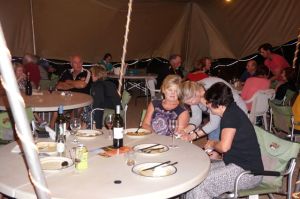
The girls planning tomorrows travel

The girls planning tomorrow’s travel at the bush dinner

Monday night we did the social thing and rocked up to the ‘outback’ dinner put on by the station. Again it was nothing flash but we met some great people and it all forms part of the journey.

Tomorrow morning we continue westward to Halls Creek. We plan to drop in to see Nick and Julie on the way then make a decision as to ‘where to from there’. We are committed to being in Derby by the 28th July to catch a floatplane to the Horizontal Falls. The Falls are situated at Talbot Bay in the Buccaneer Archipelago on the Kimberley Coast.

Again we are not sure if we will have cell reception between Halls Creek and Derby. If you cannot get hold of us just leave a message and we will call you back when we are able.

Here’s a bit of useless information for you but it is the only time you will see this in your lifetime. August 2014 will have 5 Fridays, 5 Saturdays and 5 Sundays. This happens only once every 823 years. The Chinese call it “silver pockets full”.

Categories: Uncategorized | 1 Comment

Last Day in Kununurra

Dearne in the Emma Gorge Pool

Dearne in the ‘freezing’ pool at the base of the Emma Gorge waterfall

I am loath to admit it but I was quite relieved to welcome the Navigator off her flight from Perth on Friday. While we all like a few days to ourselves from time to time, this separation had run its course. Welcome home angel.

On Saturday we celebrated the return to our journey with a visit to Emma Gorge. The Gorge is 75km from Kununurra, is just off the Gibb River Road and forms part of the El Questro Wilderness Park. Emma Gorge is in the Cockburn Ranges and is characterised by massive scree slopes and cliff face escarpments reaching up to 120 metres on both sides of a walking trail. A majority of these cliff faces are made up of Cockburn sandstone and massive quartz sandstone laid down some 1800 million years ago.

At the end of the Gorge, and after a 50-minute walk, we came to the Gorge’s main waterfall with a crystal clear pool below it. While the air temperature was decidedly warm the pool temperature was freezing. Dearne decided that after making the walk she was obliged to take a dip. The Captain remained ashore to undertake lifeguard duties.

We depart Kununurra tomorrow and make our way 200km west to the Purnululu National Park – Bungle Bungle. The Bungle Bungle Range rises 578 metres above sea level and has distinctive beehive shaped towers made up of sandstone, boulders and pebbles formed 20 million years ago. I have booked us a helicopter flight on Monday so we can fly over the region much to Dearne’s consternation. She is not the best with heights. There is also a number of great walks in the Park so we are looking forward to our time there.

The plan is to be in the Park for two days so we will let you know how we go.

Categories: Uncategorized | 1 Comment

Keeping myself busy in Kununurra

While Dearne has been away in Perth I have been keeping myself busy with a variety of domestic tasks and ‘getting to know’ the area adventures. I would have to say the motorhome is looking pretty smart at the moment.

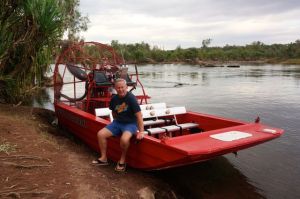
Rod on the Air Boat

Rod on the airboat before his adventure up the Ord River

About 2km from town in the Mirima National Park there is an area called Hidden Valley. The Valley contains some brilliant walking trails and some stunning rock formations. As I discovered, the rocks are vividly coloured with red and black layers as a result of millions of years of mountain building. I hate to compare our two countries but I have to admit that the history we are seeing here is amazing. I am reluctant to mention the wee walk I took yesterday when my ‘in head’ GPS malfunctioned and I had to ask for directions back to the jeep. For some of you this will come as no surprise but for others you will recognise the age ‘thingy’.

On Friday I took myself off to the Zebra Rock Gallery. We are trying to find a bit of artwork we can take home that will signify our Australian journey. Nothing is settled on yet. Situated on a mango plantation on the banks of the Ord River, the Gallery is some 16km west of Kununurra. Zebra rock is so called because of its distinctive reddish-brown and white-banded sedimentary rock from the eastern Kimberly. The rock was formed some 670 million years ago with some rock seams continuing over many kilometres. The rock has been developed into a variety of stunning artwork.

The courageous question – did I purchase an artwork? No. I shall wisely await the return of the Navigator before doing anything so bold.

I took a drive up to Kelly’s Knob yesterday (someone could have thought of a better name!!). The highpoint houses the telephone and television transmitters and storage tanks for the towns water supply. A lookout on the “Knob” provides a brilliant view of the town and the Ord River. They say that it is a great view at sunset but I did not dally that long.

I ticked another ‘must do’ adventure off my bucket list today. I went for a cruise down the lower Ord River on a purpose built airboat. I have always wanted to ride one of these. The airboat was approximately 8 metres in length, it had a 502 Chevrolet V8 engine perched on the back which was attached to three 82in air blades that drove the boat along at about 70kph.

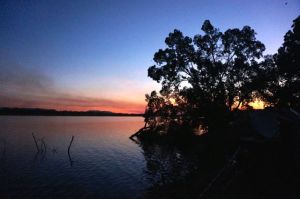
Sunset tonight from the motorhome

The end of my day today – a brilliant sunset and a quiet rum and coke at the motorhome.

The boat had amazing capabilities. We were gliding through the shallows over rocks and mud banks that would stop any other boat. We cruised the floodplains, the wetlands and mangroves that support a variety of wildlife and diverse plant life. The biggest croc we saw on our journey was about 4 metres long. He wasn’t vaguely interested in the boat even tho’ we were only a few metres away from him.

My opinion – the boat seemed to behave similarly to a jet boat i.e. it floated across the water rather than drove through it. The ride was very smooth and for the most, staying dry was no problem. Ear defenders were a must but otherwise, it was an exhilarating experience.

Tomorrow the plan is to take in the Kununurra Museum and then head off to the Lilly Creek Logoon. The Lagoon was filled after the construction of the Diversion Dam and has some great walking trails and wildlife.

Dearne is back this Friday so it is four more days of keeping myself amused. Again, what could possibly go wrong!!

Categories: Uncategorized | 2 Comments

Biding our time in Kununurra

The Team at 5 Rivers Lookout

From the Five Rivers Lookout at Wyndham L to R: Therese, Kerry, Steve, Jane, Rod, Dearne

Our layover at Kununurra has a strange feeling to it. Dearne will be in Perth from Tuesday while the Captain remains behind to look after the motorhome. This is our longest apart since 1992 and I think the Navigator is more worried about the Captains ability to cope rather than the other way around. What could possibly go wrong!

On Monday morning we drove with friends 100km north of Kununurra to the township of Wyndham on the Cambridge Gulf. With a population of 1000, Wyndham is geographically the top town of The West in relation to the Northern Territory Border and the last port northward before Darwin. The port services the areas huge cattle industry, the Ord River Irrigation Project and many mining companies.

Overlooking the town at 350 metres above sea level is the summit of the Bastion Range and the Five Rivers Lookout. We made the drive up a steep sealed road to the summit where we got a spectacular view of the rivers Ord, Forrest, King, Durrack and Pentecost entering the Cambridge Gulf. While the waters might look enticing, they are also home to the largest saltwater crocodiles in the world.

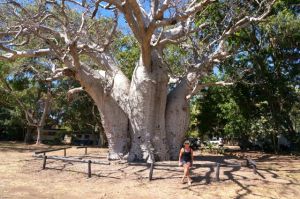
Dearne beside Boab Tree In Wyndham Holiday Park

Dearne in front of the massive Boab tree in the Wyndham Holiday Park

We did a drive through the Wyndham Caravan Park where the area’s biggest Boab tree is found. The tree is some 2000 years old, has a girth of 20 metres and with a canopy 25 metres high. They are strange looking trees but are very common around this part of Western Australia.

We also made a visit to the Wyndham’s Afghan cemetery. Located off the highway just out of Wyndham, this cemetery contains the graves of early Afghan settlers (1890s). The Afghans provided an important means of transport with their camels and donkeys, carrying food supplies and goods between towns and stations. The lead camel was always buried with his owner and facing Mecca. As you can imagine the size of the graves are somewhat larger than we are used to seeing.

After our mornings ‘work’, we lunched at the local café (the only one open in Wyndham) before making our way back the 100km to Kununurra.

Dearne headed off to Perth yesterday to visit Mia, grandchild number six and the latest addition to our family. We have both sorted out what we want to see in this region so the plan is that I will do my thing while Dearne is in Perth and the things we want to see together can wait til’ she is back on the 18th July.

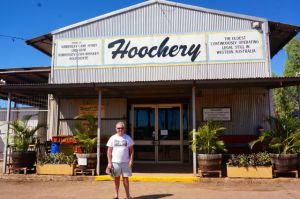
Rod in front of the Hoochery Distillery

Rod arriving at the Hoochery Distillary

This morning I made my way to the Hoochery Distillery, Western Australia’s oldest legal still. The Distillery is family owned and wherever possible uses locally grown ingredients. As many of you will know my favourite tipple is Coruba rum so I was interested to discover if any of the products made by the Hoochery was similar to the Coruba style. I couldn’t overdo the tasting because I was driving but found they certainly have a couple of nice rums but none with the Coruba taste. However, and as expected, there is a wee sample back in the motorhome.

On my way back to Kununurra I called in to The Sandalwood Factory. Set in the heartland of Kununurra’s sandalwood plantations, the factory’s parent company, TFS Corporation, holds the world’s largest resource of Indian sandalwood with over 7600 hectares of plantation across Australia’s tropical north. The factory produces a large range of sandalwood beauty, skincare and lifestyle products and if Dearne had been with me we would have probably spent a little longer than my five minutes!

It’s a big night tonight at the camp – happy hour from 5pm to 6pm then its burger and league night. Because of the west/east time difference, game starts here at 5.30pm. It should be a pleasant couple of hours.


Categories: Uncategorized | Leave a comment

Arrived Kununurra

Lake Argyle

Lake Argyle from our camping spot

Isn’t it funny how an ‘out of the way’ night stop offers the most in entertainment. Our park up at Timber Creek was one of those. We were directly behind the local hotel and only metres from a small stream. At 5pm one of the hotel employees bought a bucket of meat outside and started feeding the local falcon (kite) population and the crocodiles in the stream. We spent a brilliant hour watching the birds diving out of the sky and picking up the food that was being thrown into the air and the crocs certainly knew it was 5 o’clock – they were ready for their daily meal.

On Saturday morning we continued our journey westward passing through the quarantine checkpoint to Western Australia. We were well versed on what we could and could not take into Western Australia so we had no problems. After the checkpoint we made our way to Lake Argyle, our Saturday night stop.

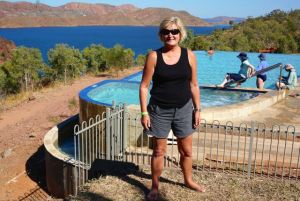
Dearne posing at Lake Argyle

Dearne ‘posing’ at the infinity pool at Lake Argyle

Lake Argyle is one of Western Australia’s most spectacular attractions. The Lake has a surface area of 1000 square kilometres and a shoreline stretching 900 kilometres. The Lake is also home to some 30,000 freshwater crocodiles. We had only planned to stay one night which was just as well – the camping area was like caravan/tent city – hundreds of them. While it was a stunning area to visit, the one night was enough. Too many people, too many dogs and lots of kids on holiday.

Saturday night for us was a biggie as we were able to celebrate the birth of grandchild number six, Mia Ruby Elizabeth, 7lb 5oz to our daughter Tiffany and partner Charles. We are a very excited family as this is our first granddaughter. Nana is flying to Perth on Tuesday to introduce herself to the new arrival while Poppa will be left in Kununurra to guard the motorhome. What could possibly go wrong!!!

Mia

Welcome to our world Mia Ruby Elizabeth – we love you xxx

We arrived in Kununurra at around midday today. Kununurra is the gateway to Western Australia and the Kimberly region. The town is one of the youngest in Western Australia and was developed through the construction of the Ord Irrigation system. The main feature of Kununurra is its extensive waterway systems. The Captain seems quite relaxed about spending a week or so on his own in this part of Australia.

Most of you will know we have had both houses in Whangamata on the market for about 2 years now. We have seen very little action in that time but as always happens, its either a feast or a famine, both houses sold last month. We are now homeless.  We flew home for four days about two weeks ago to pack the houses up and put everything in storage.

We have decided to stay in Whanga and are now trying to firm up on another house down there. We have had our eye on one for a while now so will let you know how the bartering goes. We will let you know our new address when we have one.

We are looking forward to our time in this part of Australia. There is lots to see and experience.

A message for Roy: The Captain intends taking himself off to the Hoochery while the Navigator is in Perth. I am sure he will not be disappointed.

Categories: Uncategorized | 5 Comments

Our last days in Kakadu National Park and the Northern Territory

Sunrise at Yellow Waters Billabong

Our sunrise at the Yellow Waters Billabong

We departed Jabiru on Wednesday morning and headed toward the Yellow Water area down the Kakadu Highway. We made a short stop on the way at the Kakadu Park Headquarters and the Bowali Visitor Centre. The Centre had audio-visual displays and provided visitors with a great understanding of the Kakadu National Park and the Aboriginal culture within the Park. The 60-minute stop was well worth the effort.

From Bowali we drove a further 60km southwest to Yellow Water region. Yellow Water is part of the South Alligator River floodplain and has one of the Kakadu National Park’s best known landmarks, the Yellow Waters Billabong. While we had taken a sunset cruise on the Corroboree Billabong, we had been advised by a number of travellers that the sunrise cruise on the Yellow Waters Billabong was a ‘must do’. We made the booking, which included breakfast, then went to arrange our accommodation.

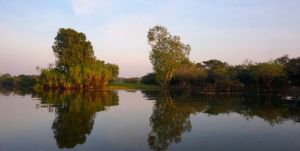
Yellow Waters Billabong

The Yellow Waters Billabong at 8am

We made our home on Wednesday night at Cooinda, a small settlement located near the Billabong but far enough away that ‘crocs’ would not be cruising around our campsite. We were up at 5.30am on Thursday morning to catch the 6.15am transport to the Billabong and our sunrise cruise. Once at the Billabong and on the boat we realised our mistake for the day – we had forgotten to bring our ‘mozzie’ repellent. As day broke, the mozzies started to attack. We were so lucky that another kind traveller lent us her repellent.

We were surprised that the Yellow Waters Billabong was so small. We had only travelled some 600 metres and were in the South Alligator River where the surrounding wetlands provided most of the tour area. This area is the most accessible and beautiful wetland area in northern Australia. When the wet season waters recede in the dry season, the wildlife is concentrated in this one part of the South Alligator floodplain. It was a stunning two hour trip that provided us with a magnificent sunrise, a informative narrative from our guide and best of all, we were able to view a broad variety of wildlife that make the wetlands their home. We had our closest ever encounter with a croc in the wild. While we had the safety of the boat, there was only a metre between us.

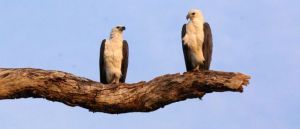
A pair of sea eagles at the Yellow Waters Billabong

At just over 1m high and with a wingspan of 2.5 metres, this pair of sea eagles made for a stunning sight at the Yellow Waters Billabong

When the cruise came to an end we were bussed back to Cooinda and tucked into a hearty breakfast and were well satisfied that our wetland cruise expectations had been met. Overall we have had a great time in the Kakadu National Park and would certainly recommend you take the time to visit if you are up this way.

After breakfast it was back on to the Kakadu Highway and driving southwest towards Pine Creek on the Stuart Highway. We had every intention of staying the night just 2km east of Pine Creek at Pussy Cat Flats. However we arrived there at midday and did not feel like stopping so early in the day so carried on south to Katherine.

We had a quick lunch at Katherine, picked up our coffee pods from Post Shop that had been couriered to us by Nepresso, posted a couple of parcels then drove west on the Victoria Highway to start our west Australia journey.

Our home for Thursday night was a free camp at Limestone Creek, a rest area 58km southwest of Katherine. There was plenty of room and shade and we were joined by about 20 other vans during the afternoon.

This morning was another one of those late starts. We didn’t get away from Limestone Creek until after 10am and it was 150km to our next over night stop at Timber Creek.

Gregory National Park

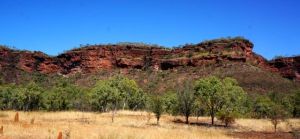
The magnificent red rock escarpments in the Gregory National Park

It was an easy drive along the Victoria Highway and through the Gregory (or Judbarra) National Park. The Park lies in the transitional zone between the tropical and semi arid regions of the Northern Territory. The standouts for us in the Park were the spectacular soaring red escarpments and we stumbled upon a flock of around 200 black cockatoo that had settled in trees reasonably close to the road. We had seen the odd one or two in our time in the Territory but never a group this big. It was a great sight.

We are now parked up at Timber Creek for the night and will make our way to Lake Argyle tomorrow morning. Once again telephone reception is average up here so if we do not answer, leave a message and we will return your call when we can.

Categories: Uncategorized | 2 Comments

Darwin now Behind Us

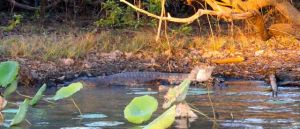
A 'salty' along the Mary River

A’saltie’ resting on the river bank near our overnight stop on the Mary River

We departed Darwin on Sunday with a definite plan in mind. Our friends Steve and Jane recommended that before we head into the Kakadu National Park we spend some time in the Mary River National Park some 150 km east of Darwin via the Arnhem Highway. The Mary River National Park protects a part of the Mary River catchment that includes the river, flood plains, billabongs, swamps and rain forests. Birdlife and crocodiles are prolific and the river is home to the famous fighting fish, the barramundi.

We made our home for two nights at the Mary River Wilderness Retreat, a great little camping spot beside the Mary River. We were advised to stay at least five to ten metres away from the waters edge at all times as ‘crocs’ were patrolling the river. Our neighbours told us they had seen a croc pulling a young bullock calf up the river that morning. We are heeding all advice I can assure you.

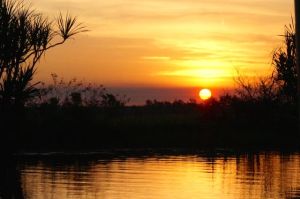
Sunset at Carroboree Billabong

Sunset on our Carroboree Billabong Sunset cruise.

There were some great little walks at the Retreat. We were able to wander around the 1.5km Wallaby Walk, so named because of the abundance of wallaby in the area or when we were feeling a bit more energetic there was the 3km Bamboo Walk or the 8.5km River Walk. We managed to get in all three. The ‘salties’ basking in the sun along the riverbank were a constant reminder of the 5 metre rule.

Sunday night we did a sunset boat cruise on the Corroboree Billabong. The billabong is the largest in the Mary River Wetlands and has the biggest concentration of saltwater crocodiles in the world. We were told that there are 45km of navigational waterway on the billabong and there are 10 crocodile for every kilometre of water.

During the safety briefing before the cruise we were advised that if we should fall in the water that we should not panic or splash about as that apparently attracts the crocodile as they think it is a wounded animal. Thank goodness we were never put to the test as all our disaster recovery plans had a mild component of ‘panic’ involved. All that aside, it was a stunning couple of hours on the water – the animal and birdlike were amazing.

This morning we made our way into the Kakadu National Park with the goal of making Jabiru our home for the night. Jabiru is some 250km east of Darwin or 150km east of Mary River, our home for the last two nights.

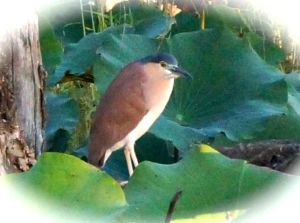
Birdlife at the Billabong

A Nankeen Night Heron casually watching us pass by on the Billabong cruise. The bird is at least 75cm high.

Kakadu (or Kakadon’t, depending on your view of the area) is about 20,000 square kilometres and is a diverse landscape ranging from coastal sand dunes and tidal flats to elevated rocky creeks and plunging waterfalls. Rainforests, wetlands and huge tidal rivers make up the landscape. On our way to Jabiru we crossed the Southern Alligator River and were quite relaxed about seeing four and five metre salties either basking in the sun on the riverbank or swimming in the river. It’s amazing how your attitude changes and accepts without question the risks of your surroundings. While not ignoring the risks, one adjusts one behaviour to best manage the risk.

We arrived in Jabiru at about midday and made our home for the night at the local caravan park. Once we had settled in, we unhitched the jeep and drove another 40km to Ubiir on the Arnhem Land boarder. Ubiir boasts the most exquisite rock art in the area and it is said to date back some 5000 years. The Captain struggles with the originality of the art as he heard a rumour that at times the local indigenous prison inmates are employed to ‘touch up’ the art for the tourists.. One will never know I guess.

Tomorrow the plan is to head south to Cooinda. Cooinda is only about 50km from Jabiru but it is close to the famous Yellow Waters Billabong. The Captain wants to get onto one of those flat bottom boats with the big airplane propeller on the back. – maybe this will be it.

Categories: Uncategorized | 3 Comments

Create a free website or blog at WordPress.com.